by Adrian Hatwell
from BusinessDay.co.nz
Australian-owned ANZ Bank has won the annual Roger Award for worst transnational company operating in New Zealand, due to its leading role in the nation’s financial sector strife.
A panel of five judges said foreign-owned banks in general were a large drain on New Zealand’s economy.
Allegations of distortions of lending margins, tax avoidance, risky lending practices, overcharging, and poor customer treatment were rife, the judges said.
However the ANZ’s behaviour during 2009, particularly its part in the ING funds fiasco, made the bank the unanimous pick for the top title, they said.
ANZ did not respond to requests for comment on its Roger Award win.
Murray Horton, secretary for Campaign Against Foreign Control of Aotearoa, the award’s organiser, describes the annual event as a sort of “people’s court” in which the public nominate candidates and a panel of experts weigh the facts and evidence before making a judgment.
Dr Joce Jesson, senior lecturer in critical studies at Auckland University and one of this year’s judges, believed the award blows apart the bank’s careful PR campaign and shows the public the company’s true face.
“The banks want you to believe that they are there for you, but no, the bank is there for [its foreign owners],” said Dr Jesson.
“We need to start recognising that these banks rip money out of New Zealand.”
Fellow judge, Dr Wayne Hope, associate professor of communications studies at AUT University, agreed that although ANZ had distinguished itself above its competition, the award indicated problems with the transnational-focus of the banking system in general.
“The judges’ report is important,” said Dr Hope, “because it contributes to the ongoing public debate about what it is that banks do, and the need for people to get a fair deal.”
One of the leading factors in ANZ’s win was its handling of last year’s ING affair, which saw 13,000 small investors misled into taking money out of safe term deposits and moving it into high-risk funds, which were then frozen as their value plummeted.
The Frozen Funds Group represents 1,100 of those affected in the ING fiasco, many of who are elderly and lost their entire savings in the funds.
FFG spokesperson Gerard Prinsen was delighted with ANZ’s Roger Award win.
"It’s fantastic,” Prinsen said. “They battled hard and did their utmost best, they deserved to win. Totally.”
He was particularly impressed with the way the bank had upset almost every party in parliament.
“[It put] Act, Labour, and the Greens all in the same boat to row against the ANZ.”
The Commerce Commission will conclude a 17-month investigation of ANZ’s handling of the ING matter at the end of the month. If the bank is found to have breached the law then compensation could be paid to investors.
Prinsen said that although the system may be slow and complex, the progress of the Frozen Funds Group shows that it does work.
The Roger Award judges were less confident in the current system’s ability to keep banks honest and urged further government regulation.
There was general agreement that one thing people can do to avoid the issues raised by this year’s award is to move their business from Australian-owned banks to local alternatives.
“Many of the people [burned in the ING affair] have been lifetime customers of the ANZ, for 50 to 60 years,” said Prinsen. “To see the bank treat you like this, it really hurts.”
Rio Tinto Aluminium was the runner-up for the 2009 award, with Telecom in third place. The Auckland City Council was awarded the Accomplice Award for its part in privatising the city’s waste management system through Transpacific Industries Group.
Showing posts with label ANZ National Bank. Show all posts
Showing posts with label ANZ National Bank. Show all posts

13.3.10
Bad Bank wins Roger Award

ANZ has won the Roger Award for the worst transnational corporation operating in New Zealand in 2009. Below is the judge's statement relating to the winner, ANZ. The judges were Christine Dann, Bryan Gould, Joce Jesson, Paul Corliss and Wayne Hope.
The Roger Award is organised each year by CAFCA (Campaign against Foreign Control of Aotearoa).
From the judge's statement:
The Winner: ANZ
The judges all noted the generally egregious behaviour of the Australian-owned banks that were nominated (ANZ, BNZ and Westpac), and were unanimous in picking them as the worst TNCs operating in New Zealand in 2009.
As the Council of Trade Unions noted in its submission to the Independent Parliamentary Banking Inquiry, the foreign–owned banks are the Achilles heel of the New Zealand economy, given that they contribute to the lion’s share of the national debt. They account for nearly 70% of investment income debts on the national balance of payments and for 74% of the economy’s net overseas indebtedness.
During the 2009 year the banks were accused of:
1. Distorted lending margins in their favour and against their customers
2. Tax dodging on a grand scale
3. Poor lending and investment practices
4. Overcharging and profiteering
5. Poor employment and customer service practices
The banks behaved so badly in 2009 (and 2008) that they were the subject of a Parliamentary Select Committee investigation early in 2009. Despite receiving reports giving good reason to conclude that strong Government action was needed to rein in the bad behaviour of the banks, and to require them to deal with both customers (and the Government, which provided them with security during the 2008 financial crisis) more honestly and fairly, the National Party-dominated Select Committee did not recommend such actions to Government. This led to the Labour, Green and Progressive MPs setting up their own Independent Parliamentary Banking Inquiry. This Inquiry exposed more issues of concern, and called for better legislation and regulation to protect the public from predatory banks.
Also during 2009, bank after bank appeared before the High Court to answer allegations of tax evasion, amounting to billions of dollars. After high level negotiations they finally reached an out-of-court settlement that saw them collectively pay the Inland Revenue Department more than $2.2 billion. In a political climate where we are constantly being told that taxes are an evil imposition, rather than what they really are - the price we pay for a democratic and functional society - we think that a special Public Heroes award should go to the Government lawyers, IRD officials and others responsible for getting these slippery banking snakes to pay what they rightly owe the nation.
One of the Roger Award judges noted the banks were richly deserving of the Award since they have been ''...doing great damage for many years to the whole of the New Zealand economy …through irresponsible lending (thereby stoking inflation), and expatriating excessive profits … while all the time avoiding censure and pointing the finger at public spending as the cause of our economic problems…[While] this year we have seen the truly scandalous tax avoidance saga, from which the banks have again escaped remarkably lightly; if you or I had committed a similar offence of one thousandth the size we would have ended up in jail.”
However, it was a tough decision to pick the worst of the worst, considering that all the foreign-owned banks were guilty of some degree of tax dodging, overcharging on credit card fees and loans, not passing on reductions in interest rates, and treating customers and staff poorly. In the end the judges decided that ANZ deserved top place, with the ING scandal tipping the balance in its favour (for full details of the ING scandal, see the next section “Rattlesnakes In the Grass’).
In 2008 ANZ was also a finalist, with the 2008 judges noting the following ‘fine’ qualities for its inclusion:
“Evidence presented to the judges portrayed ANZ-National as the most rapacious, inept and irresponsible of the banks over the past couple of years, which assured it a good chance of securing the Roger Award. This bank was a distinguished finalist in 2007 also, for its despicable role in the saga of Godfrey Hirst and the Feltex carpet business”.ANZ has succeeded in winning the 2009 Roger Award because the ING funds fiasco is simply and plainly ‘pure greed capitalism’ at its worst. This debacle saw the bank immorally misleading small investors into taking their money out of safe term deposits and putting it into highly risky investments, while assuring them that these investments were safe. In fact, most of them were highly dangerous and dodgy, and lost millions of investors' money. When the betrayed investors got organised and put pressure on the bank to repay what had been lost, ANZ's repayment offer came with big strings attached - investors who refused to sign a waiver agreeing not to take legal action against the bank would receive no compensation. In the words of the judges, this was ‘the most extreme case of anti-democratic manipulation by a transnational within New Zealand during 2009. Simply, ANZ was employing financial pressure to erase the legal rights of investors – a truly Roger winning performance.’
The ING debacle was, as one judge noted, ‘the icing on the already baked Roger cake.’ Thus ANZ is the winner of the 2009 Roger Award.
24.8.09
Launching the Bad Banks campaign
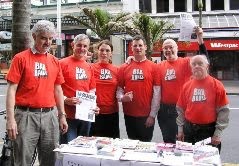
The operations of the Big Four Australian-owned banks, ANZ National Bank, BNZ, Westpac and ASB, are harmful to the lives of grassroots people in New Zealand.
Socialist Worker-New Zealand is launching a campaign to shame and expose these Bad Banks.
We welcome other groups, organisations and individuals producing their own publicity that targets the Bad Banks.
The initial thrust of the on-the-street campaigning will be educational, building towards campaign demands that reflect a dialogue between broad left activists and grassroots people.
Why these Banks are Bad:
• They've made mega-profits by interest gouging grassroots Kiwis. The profits of the Big Four banks totaled over $3 billion in 2008, up 3.7% on the year before.
• They've used market dominance to keep interest rates high. In 2008, the banks income from loan interest went up $4.6 billion.
• They're forcing mortgagee sales in increasing numbers. There will be many more, unless we stop the banks.
• They're trying to avoid paying a $2.25 billion tax bill. BNZ has already been convicted by the High Court and told to pay up.
• They helped inflate the “housing bubble” in NZ. Average mortgages have ballooned to ten times the average wage, putting a huge financial strain on modest income homeowners.
Subscribe to:
Posts (Atom)



 Posts

