by Matt McCarten
from NZ Herald
13 December 2009
The Australian banks last week had their Prime Minister scolding them to take a hard look at themselves. That's because they snuck through an interest rate rise after their Reserve Bank raised its rates.
Westpac was the worst with a 45-point hike, even though the Reserve Bank raised the rate by only 25 points.
Westpac rubbed salt into its customers' wounds by sending them an email comparing the bank's profit-gouging decision to a situation when a tropical storm hits a banana plantation. Apparently, such an occurrence would increase the price of a banana smoothie.
Of course, the comparison was dishonest and patronising.
A bank's unethical profiteering that puts people in a situation of not being able to pay their mortgage is outrageous enough. But comparing it with paying more for a banana smoothie has caused a furore in Australia.
Westpac won't want that public relations disaster following it over here, given it has announced it is making over its New Zealand brand to show how much it cares about us.
The other Australian banks (ANZ, ASB, BNZ and National) have followed with a charm offensive, too. There are lots of soothing words about how they want to get closer to New Zealanders by opening more branch offices and offering more intimate services.
It's a bit hard to understand their strategy, given they recently sacked hundreds of Kiwi bank tellers and shipped their work offshore to call-centre factories. It seems only yesterday we were being told local bank branch closures would save us money.
Despite those rather inconvenient truths, the public relations campaign to win our goodwill is well under way. Recently, BNZ proudly promoted its public spirit credentials by closing its doors for a day and paying its employees to do community work for the day.
I'm not trying to piss on the parade, but the day after, I was in a BNZ bank and the staff were running ragged. One of them dryly noted that BNZ got good publicity, but it also meant the workers had to fit five days' work into four days that week.
One of the BNZ's main competitors, the ASB Bank, is now rebranded as the "caring bank". It also claims to have been a "Kiwi bank since 1847".
I doubt the Commonwealth Bank of Australia is aware of the new change of ownership.
It seems that the new initiatives to win our favour are twofold. Despite the widespread political opposition and scepticism to setting up a publicly owned community, Kiwibank has gone from strength to strength as many New Zealanders have swapped their bank accounts over. Nationalism and sovereignty are strong emotions.
The second reason is the public mood is going dog on them. There's been too much news about interest fixing, exorbitant fees and the outrageous tax evasion cases now before the courts.
That's on top of the increasing numbers of ordinary New Zealanders losing their homes as the banks start foreclosing on them.
Vaughan Gunson from the Bad Bank campaign claims the Australian bank owners are terrified that the public sentiments will lead to politicians on both sides of the Tasman following their American colleagues and regulating the industry to curb its excessive profiteering. Gunson blames the banks for causing the financial crisis that almost collapsed the global economy.
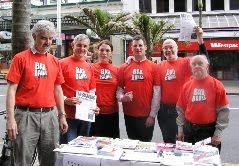
The Bad Bank supporters picketed a bank in downtown Auckland on Friday as part of their campaign to force the Government to hold a formal inquiry into the role of banks in this country.
Westpac ran a stupid banana campaign, says Gunson, but the whole world banking system has gone bananas. One slip on a skin and we're all gone.
The Government's siding with the Australian bank owners in not holding an inquiry makes me nervous.
Showing posts with label public inquiry. Show all posts
9.12.09
Interview with Andrew Campbell, campaigns director for the bank workers union, Finsec
The back page of Bad Banks leaflet #5 features an interview with Andrew Campbell, campaigns director for the bank workers' union, Finsec. ASB Bank is the only major bank operating in NZ which is not unionised. ASB bosses have taken an anti-union stance. Andrew heads up Finsec's "Better Banks" campaign, which is about getting better pay and industry standards for bank workers, but is also about refoming the way the banks operate in New Zealand. Finsec wrote a submission to the parliamentary inquiry initiated by the Greens, Labour and Progressive parties. They still support a full public inquiry into the banks. Is it "Kiwi" to be anti-union?
“ASB is a deunionised bank.” That’s the situation at ASB Bank according to Andrew Campbell, campaigns director for Finsec, the bank workers union.
“They’ve made it very difficult for ASB workers to be part of a union”, says Andrew. “Whilst Finsec hasn’t actively organised in there in recent years, the last time we did, we faced stiff opposition. They made it very very clear to people that they viewed the union as a negative.”
“People close to the union, or who joined the union, were spoken to by management. Anti-union information was circulated at the time. Even though it was made clear that you had the legal right to join, all evidence to the contrary was put up, so that joining the union was seen as an act of hostility to the employer. That’s a very scary situation to put people in”, says Andrew.
No union means that ASB bosses have more power over their staff. This year, all ASB employees earning over $50,000 have been subjected to a wage freeze. This will affect 3,500 of the bank’s 4,700 staff nationwide.
The low bar compares unfavourably with that being used by ASB’s parent company in Australia, Commonwealth Bank, where the wage freeze is for staff earning over $100,000.
“There’s evidence that workers at ASB are losing out because they aren’t able to collectively bargain”, says Andrew. He believes ASB can afford to pay more, “their profits are comparable to the other banks”.
Finsec have an ongoing campaign called “Better Banks”, which aims to achieve better pay and industry standards across the banking sector.
Better Banks is also about bringing the banks into line. “We think the banks need to change how they operate”, says Andrew, who heads up the campaign.
“They need to start operating in the interests of the NZ economy and their NZ customers, rather than in the interests of their Australian shareholders. They need to be more ethical, they need to be more regulated, and they need to stop taking the NZ taxpayer for granted.”
Andrew was disappointed the National government didn’t support calls for a full public inquiry into the banks: “We think the banks lobby got in Bill English’s ear, which shows which side National is on. They’re on the side of big banks, not NZ workers.”
Finsec still wants to see a full public inquiry, “but we want to see real changes”, says Andrew, “not just a talk fest”.
“Workers and customers will have to be active to pressure politicians to make the fundamental changes to the banking system we all need.”
2.9.09
“We need a full public inquiry into banking operations,” say Bad Banks campaigners
Bad Banks media release
2 September 2009
The operations of the Big Four Aussie-owned banks are harmful to the lives of ordinary Kiwis,” says Vaughan Gunson, publicity coordinator for Bad Banks, a recently initiated grassroots campaign against banking power.
ANZ National Bank, BNZ, Westpac and ASB have been making mega-profits from interest gouging grassroots Kiwis. In 2008, their combined income from loan interest went up $4.6 billion. Last year the profits of the Big Four totaled over $3 billion.
“And now, in a recession, these Bad Banks are king-hitting people who have lost their jobs or had their incomes cut,” says Gunson. “They’re inflicting penalties on people who can’t meet their mortgage payments and forcing mortgagee sales in increasing numbers.”
“They’re looking after their own equity position and chucking people out of their homes. It’s disgusting. These Bad Banks are part of a corporate culture of greed that’s sucking the life out of this country,” says Gunson.
While it's good that the Green, Labour and Progressive parties have gone ahead with their banking inquiry, the time frame for submissions was very short. That means there are only 11 oral submissions.
“11 oral submissions does not do justice to the devastating impact banking power is having on the lives of grassroots Kiwis,” says Gunson. “We need a full public inquiry, properly resourced and promoted, so that grassroots people can have their say and the Aussie-owned banks be held to account.”
“Any full public inquiry should allow for public meetings up and down the country, so that grassroots people can tell their stories.”
“We hope that MPs in the Green, Labour and Progressive parties are going to be part of an ongoing campaign against the banks,” says Gunson. “We need to confront corporate power full-on.”
The first goal of the Bad Banks campaign is to educate people about the operations of the banks. Bad Banks activists will be out on the streets in Auckland and other cities handing out leaflets and talking to people over the coming weeks and months.
“People can find out more about Bad Banks by going to our webpage www.badbanks.co.nz. We welcome any stories or comments on the banks,” says Gunson. “We’re looking to reach out to other groups, organisations and individuals to help build this campaign.”
2 September 2009
The operations of the Big Four Aussie-owned banks are harmful to the lives of ordinary Kiwis,” says Vaughan Gunson, publicity coordinator for Bad Banks, a recently initiated grassroots campaign against banking power.
ANZ National Bank, BNZ, Westpac and ASB have been making mega-profits from interest gouging grassroots Kiwis. In 2008, their combined income from loan interest went up $4.6 billion. Last year the profits of the Big Four totaled over $3 billion.
“And now, in a recession, these Bad Banks are king-hitting people who have lost their jobs or had their incomes cut,” says Gunson. “They’re inflicting penalties on people who can’t meet their mortgage payments and forcing mortgagee sales in increasing numbers.”
“They’re looking after their own equity position and chucking people out of their homes. It’s disgusting. These Bad Banks are part of a corporate culture of greed that’s sucking the life out of this country,” says Gunson.
While it's good that the Green, Labour and Progressive parties have gone ahead with their banking inquiry, the time frame for submissions was very short. That means there are only 11 oral submissions.
“11 oral submissions does not do justice to the devastating impact banking power is having on the lives of grassroots Kiwis,” says Gunson. “We need a full public inquiry, properly resourced and promoted, so that grassroots people can have their say and the Aussie-owned banks be held to account.”
“Any full public inquiry should allow for public meetings up and down the country, so that grassroots people can tell their stories.”
“We hope that MPs in the Green, Labour and Progressive parties are going to be part of an ongoing campaign against the banks,” says Gunson. “We need to confront corporate power full-on.”
The first goal of the Bad Banks campaign is to educate people about the operations of the banks. Bad Banks activists will be out on the streets in Auckland and other cities handing out leaflets and talking to people over the coming weeks and months.
“People can find out more about Bad Banks by going to our webpage www.badbanks.co.nz. We welcome any stories or comments on the banks,” says Gunson. “We’re looking to reach out to other groups, organisations and individuals to help build this campaign.”
Subscribe to:
Posts (Atom)