by Paola Harvey
from Green Left Weekly (Australia)
30 January 2010
Although New Zealand, like Australia, has not been as badly affected by the global economic crisis as the US or Europe, workers are facing hardship.
Bronwen Beechey, an activist from Socialist Worker New Zealand (SWNZ), told Green Left Weekly: “There’ have been a lot of redundancies, places have been closed down.”
Beechey and SWNZ activist Peter Hughes were in Sydney to attend the January 3-6 Socialist Alliance national conference. They spoke to GLW about the SWNZ’s “bad banks” campaign, which takes aim at the cause of the global financial crisis — neoliberal capitalism.
“For people on low incomes life’s just been getting tougher because [they are] losing their jobs and food prices and rents and all of it have not come down substantially”, Beechey said.
“All the indicators, the social services, people asking for assistance, for food parcels, people losing their homes — they’ve all skyrocketed.”
Hughes said employers have used the crisis to justify attacking workers’ wages and conditions. “In the last 12 months, there have been no less than eight lockouts of workers.
“One of the most shameful examples was a service provider for the elderly that insisted that if the workers in that field did not accept the minimum wage [NZ$12.50 per hour] they’d be locked out.
“That’s quite a serious indication of how they [the bosses] see the crisis being resolved to their advantage and workers’ disadvantage.”
The New Zealand government’s response has been the same as capitalist governments around the world — bail out the banks and the big capitalists, and make the workers pay.
But they are not getting it all their own way. The government’s attempt to impose an unofficial wage freeze in the public service was recently challenged. Support staff in the education sector won a small wage rise.
That win will set the tone for the upcoming nurses’ and general education unions’ wage negotiations. “No less than that, will be the call, I’m sure”, said Hughes. “So that’s a good sign.
“I heard at the [Socialist Alliance] conference, that [Australian Prime Minister Kevin Rudd] said that the recovery’s going to be worse than the recession.
“I’m quite sure that’s their intention for us in New Zealand as well, working people will be made to pay for the recovery — if there’s going to be one.
“But our assessment is that there can be no real recovery in the current market economy, not in the foreseeable future. That’s going to lead to all sorts of crises for them, which they will try to push on us.
“We have to organise people to resist that.”
The discussion about neoliberalism at the NZ Council of Trade Unions’ 2009 conference has opened up more space on the left to fight back against these future crises.
At the conference, union activists talked about workers’ cooperatives, building and strengthening the union movement and not accepting the neoliberal capitalist model as the only option.
Beechey said: “It also talk[ed] about climate change and the need for an alternative economic strategy which is an implicit criticism of neoliberal capitalism.”
Hughes added: “While it’s not a policy position as such, it’s a discussion that’s been opened up within the trade union movement.
“It’s not an accepted policy, it could be watered down significantly and it’ll come down to how different unions interpret that for building a broader perspective in the membership.
“[But] when you think about how closely linked the trade union movement has been to the Labour Party … this is a departure.
“The fact that they’re daring to criticise publicly this position opens up a space on the left for us to work with trade union activists in a much more healthy and progressive way.”
Many people in New Zealand continue to struggle with little indication of their situation improving in the near future.
There has been an increase in the number of houses sold due to people defaulting on their home loans. A large proportion of these have been people with one home — not property speculators.
Hughes said the defaulters “simply cannot pay because they’ve lost their job, they’ve been made redundant and they have reduced incomes”.
“That’s pretty devastating for families and has shown no sign of abating at all.”
The actions of the banks have been completely shameful. Before the crisis, banks were advertising loans for 100% of the price of a house.
But after the crisis, their ruthless approach to lending has meant many people who were lured into the property market by these loans have had their home repossessed.
“Our campaign around ‘bad banks’ is trying to make them pay really”, said Hughes. “Because they’re the ones that have played a big role [in the crisis] and they’re plundering the profits of working people.”
The bad banks campaign is focusing on demystifying what the banks actually do and how they caused the financial crisis. It is also calling for a financial transaction tax, as opposed to a goods and services tax.
A GST is a regressive tax, that is it affects the poorest the most, because the poor are taxed the same as the rich for goods despite having less ability to pay.
A financial transaction tax, on the other hand, would be a progressive tax. It would affect banks, corporations and the wealthy the most, because they account for the vast majority of financial transactions.
“We see the bad banks campaign as striking right to the heart of neo-liberalism”, Hughes said. “These banks have got their fingers in the lives of every working class person, whether it’s controlling their mortgage, their credit card, or their bank charges.
“They’re bloody pillaging basically. Their pockets are huge, they’re not paying their taxes.
“They’re not very popular with workers at the moment.”
Showing posts with label mega-profits. Show all posts
Showing posts with label mega-profits. Show all posts

9.1.10
Finsec Union slams Aussie-owned banks
from TVNZ website
Australian-owned banks are being accused of looking after their overseas shareholders at the expense of local jobs and the New Zealand economy.
The bank workers' union FINSEC says huge dividends have been handed out while jobs are being cut or contracted out to offshore operators.
Spokesman Andrew Campbell says he is also unhappy at wage freezes and branch closures. He believes ANZ National is the biggest offender.
Campbell says it's time the government got tough over what he calls an immoral disregard to the local economy. He says all through the recession the banks have been turning healthy profits.
Australian-owned banks are being accused of looking after their overseas shareholders at the expense of local jobs and the New Zealand economy.
The bank workers' union FINSEC says huge dividends have been handed out while jobs are being cut or contracted out to offshore operators.
Spokesman Andrew Campbell says he is also unhappy at wage freezes and branch closures. He believes ANZ National is the biggest offender.
Campbell says it's time the government got tough over what he calls an immoral disregard to the local economy. He says all through the recession the banks have been turning healthy profits.
28.10.09
Why Do Bankers Make So Much Money?
Below are some instructive comments from Rick Bookstaber, formerly a senior risk manager and derivatives creator for big banks in America.
Speaking from the point of view of a somewhat cynical insider who retains his essential faith in "free markets", Bookstaber comments: "I think the invocations of talent for money producers in finance are akin to those that, in times past, were set aside for the mystical powers of saints and witches."
Speaking from the point of view of a somewhat cynical insider who retains his essential faith in "free markets", Bookstaber comments: "I think the invocations of talent for money producers in finance are akin to those that, in times past, were set aside for the mystical powers of saints and witches."
Why Do Bankers Make So Much Money?
by Rick Bookstaber
23 October 2009
A tenet of economics is that in competitive markets there are no economic rents. That is, people get fairly paid for their efforts, their capital input, and for bearing risk. They are not paid any more than is necessary as an incentive for production. In trying to understand the reason for the huge pay scale within the finance industry, we can either try to justify the pay level as being a fair one in terms of the competitive market place, or ask in what ways the financial industry deviates from the competitive economic model in order to allow economic rents.
Do the banks operate in a competitive market?
No one expects competitive levels of compensation when there are deviations from a competitive market. In what ways might the banks – and here I mean the largest banks and those banks that morphed over the past year from being investment banks – fall away from the model of pure competition?
One way is through creating inefficiencies to keep competitive forces at bay. Banks can do this, for example, by constructing informational asymmetries between themselves and their clients. This gets into those pages of small print that you see in various investment and loan contracts. What we might call gotcha clauses and what the banks call revenue enhancers. And it also gets into the use of complex derivatives and other “innovative products” that are hard for the clients to understand, much less price.
Another way is to misprice risk and push it into other parts of the economy. The fair economic payoff increases with the amount of risk taken. If a bank takes on more risk it should get a higher expected payoff. If the bank can get paid as if it is taking on risk while actually pushing the risk onto someone else, then it will start to pull in economic rents. The use of innovative products comes up again in this context. They provide a vehicle for the banks to push risk to others at a less than fair price. Or, they can push the risk onto the taxpayers by hiding the risk and then invoking the too-big-to-fail protections when it comes to be realized. The current “heads I win, tails you lose” debate centers precisely on this point.
A third, and most obvious reason banks might not be economically competitive entities is the organization of the industry. There are barriers to entry. No one can just decide to set up a major bank. And there are constraint in the amount of business any one bank can do. As we have seen with Citigroup, there finally are diseconomies of scale – after a point the communication and management issues make the bank less efficient and more prone to crisis. If there is fixed supply, then the banks can push up the price of their services. The crisis over this past year has made matters worse. If you are one of those still standing, you are a beneficiary of that crisis, which has choked off the supply even further.
Are the workers getting paid fairly for their efforts?
An alternative to the idea that the industry is not competitive is that the industry really is competitive and those who are getting these outsized paychecks are being fairly compensated for their efforts. This comes back to the term we hear bandied about in conversations on banker compensation: talent.
There is no denying there are many smart people in the banking industry. (Though I think from a social welfare standpoint, we might have done better if some of those physicist and mathematicians that populate the ranks of the banks had found greener pastures in, say, the biological sciences). But I don’t buy the notion that there are so many who have the level of talent that justifies tens and even hundreds of million in compensation. I think this level of compensation, and the notion of talent behind it, is the result of the inherent uncertainty in the financial enterprise, one that makes it very difficult to assess talent. Indeed, I think the invocations of talent for money producers in finance are akin to those that, in times past, were set aside for the mystical powers of saints and witches.
Far more than other fields of endeavor, it is difficult in finance to tell if someone is good or lucky. A top trader or hedge fund manager might have a Sharpe Ratio of 1.0 or 2.0.But that Sharpe Ratio is nothing less that a statement that if you get a hundred people trading, a few will do well just by luck. (And it doesn’t matter if that Sharpe Ratio occurred over the period of one year or twenty – though the greater sample size helps, it is still the same point in terms of statistical inference, so a long track record does not get you away from this problem).
How does this tie in with saints and witches? People want certainty, and if they can’t get the certainty they want from the empirical, they fall back on superstition and witchcraft, or at least they used to way back when. In some medieval village, a priest prayed and a supplicant was healed. The odds that the supplicant would have healed spontaneously was whatever it was, but there was more of a sense of certainty to feel that it was the manifestation of healing power.
There were false saints and true saints. The difference between them became manifest over time by how frequently the prayers were answered with affirmative results. Not that any saint had to bat a thousand. Sometimes there were understandable, exogenous circumstances that inhibited the saint’s healing talents from being operative, most commonly a lack of righteousness on the part of the supplicant, occasionally an inevitability, a higher power that overshadowed that of the saint. Maybe the will of God, maybe an unknown, evil curse.
I hope the analogy is apparent. And there is a related one, an analogy to Pascal's Wager. The bank should wager that the talent of its star employee exists, because it has much to gain over time if it does, while if it does not exist, the bank will lose little in expected terms. And in a competitive world, it is even worse if they incorrectly let the talent go for lack of proper compensation, because then some competitor will pick it up.
24.9.09
BAD BANKS: Targeting late capitalism's exploitation of labour and nature
by GRANT MORGAN
Socialist Worker-New Zealand
World capitalism's boosters, led by US Federal Reserve chair Ben Bernanke, are welcoming economic "green shoots" and proclaiming "the end of recession".
Nobody has a crystal ball, and yes, at some stage the global economy will start to recover, even if only partially and temporarily. But we need to look at the bigger picture if we are to have any idea of what might lie ahead.
SHARE MARKET BUBBLE
At present, the economic "recovery" is first and foremost a recovery in share market prices, while global unemployment continues to rise and real wages are being driven down.
The levels of unemployment and wages are a much safer way to assess the real state of the real economy than share market fluctuations. What we are now seeing is a share market bubble disconnected from rising unemployment and falling real wages.
Late capitalism increasingly depends on financial and asset bubbles which are disconnected from the real economy.
PROFITABILITY CRISIS
Obviously, that means financial and economic instability is going to be not only more endemic than during early or middle capitalism, but also more catastrophic in its effects. That we saw during the Great Implosion of September 2008 which came close to collapsing the world system's financial structures.
Late capitalism's increasing dependency on financial and asset bubbles is a key symptom of something deeper. The world system is finding it much harder to translate the mega-accumulation of capital into the maximised profit margins which alone can sustain the global rule of ever fewer monopolists.
Many analysts have pointed to the increasing disconnect between rising labour productivity and falling consumer demand, leaving the world economy awash with unwanted consumer goods and excess productive capacity. That is an obvious driver of the world system's profitability crisis.
REVENGE OF NATURE
But there are other drivers as well. Hand-in-hand with the exploitation of labour, the exploitation of nature is creating an existential gulf between human sustainability and corporate profitability.
Since its birth 500 years ago, capitalism has been dependent on the free lunches provided by labour and nature. Without the state-sanctioned looting of nature, the world system could not meet its profit needs, any more than it could without the state-sanctioned wage slavery of workers.
Now we are seeing the revenge of nature, most notably in the rising tides of global warming, but also in the resource depletion and chain-reaction pollution which will intersect with climate change in dangerously unpredictable ways.
TERMINAL CANCERS
Unless checked by a global mobilisation, climate change will kill millions and perhaps billions of people on the planet, unleashing a mega-crisis which kills capitalism. Yet any such global mobilisation will fatally undermine corporate profitability and thus kill capitalism anyway, maybe even quicker.
Late capitalism is being eaten away by terminal cancers.
Yet we cannot simply stand by and wait for something better. The elites who run late capitalism will stop at nothing to transfer their power and privileges to a post-capitalist world which is almost certain to be even more barbaric. That is the road to a mass die-back of humanity and other life forms.
MANY GOOD CAUSES
So the question is: what can we do, right here and right now, to prepare the ground for a post-capitalist world which is more democratic, more equitable and more ecological than the present system.
There is no single or simple answer to that question. The struggles of many leftists in many countries around many causes all help, cumulatively, to make the grassroots stronger and the elites weaker.
Among the good causes that New Zealand leftists are currently promoting are the living wage, climate justice and pro-MMP campaigns.
ASYMMETRIC WARFARE
There exists a vital need to shape all such campaigns into a sharper challenge to the world system which creates the evils that necessitate the campaigns in the first place. Otherwise we are forever fighting the symptoms, leaving the system's elites far too much leeway to perpetuate themselves.
Yet any call to "fight capitalism" would lack mass appeal because it's too distant from most people's consciousness and capabilities.
How then can we proceed? The fundamental principle of asymmetric warfare, where the weak confront the strong, is to strike wherever the enemy is most exposed and wherever the most damage can be inflicted.
WIDESPREAD PUBLIC HOSTILITY
The big banks, whose colossal investments shape the very structures of all economies and, therefore, their governing politics and ideologies, are already the object of widespread public hostility.
If we direct our fire against the big banks, and get a good public response, then late capitalism will be weakened at an increasingly vulnerable yet important spot: the financialisation of the world system.
That is the strategic objective of Socialist Worker's Bad Banks campaign, launched in Auckland not long ago. It is an objective in harmony with the fundamental principle of asymmetric warfare.
WIDESPREAD PUBLIC SUPPORT
The Bad Banks campaign targets the key investment drivers who are responsible for rising unemployment, falling real wages, climate change and other evils flowing from capitalism's exploitation of labour and nature.
It is therefore a campaign which fingers the causes as well as the consequences of the evils of late capitalism. And going by early results at Bad Banks street stalls, there is widespread public support for the campaign.
To help out at a Bad Banks stall, email socialist-worker@pl.net.
Socialist Worker-New Zealand
World capitalism's boosters, led by US Federal Reserve chair Ben Bernanke, are welcoming economic "green shoots" and proclaiming "the end of recession".
Nobody has a crystal ball, and yes, at some stage the global economy will start to recover, even if only partially and temporarily. But we need to look at the bigger picture if we are to have any idea of what might lie ahead.
SHARE MARKET BUBBLE
At present, the economic "recovery" is first and foremost a recovery in share market prices, while global unemployment continues to rise and real wages are being driven down.
The levels of unemployment and wages are a much safer way to assess the real state of the real economy than share market fluctuations. What we are now seeing is a share market bubble disconnected from rising unemployment and falling real wages.
Late capitalism increasingly depends on financial and asset bubbles which are disconnected from the real economy.
PROFITABILITY CRISIS
Obviously, that means financial and economic instability is going to be not only more endemic than during early or middle capitalism, but also more catastrophic in its effects. That we saw during the Great Implosion of September 2008 which came close to collapsing the world system's financial structures.
Late capitalism's increasing dependency on financial and asset bubbles is a key symptom of something deeper. The world system is finding it much harder to translate the mega-accumulation of capital into the maximised profit margins which alone can sustain the global rule of ever fewer monopolists.
Many analysts have pointed to the increasing disconnect between rising labour productivity and falling consumer demand, leaving the world economy awash with unwanted consumer goods and excess productive capacity. That is an obvious driver of the world system's profitability crisis.
REVENGE OF NATURE
But there are other drivers as well. Hand-in-hand with the exploitation of labour, the exploitation of nature is creating an existential gulf between human sustainability and corporate profitability.
Since its birth 500 years ago, capitalism has been dependent on the free lunches provided by labour and nature. Without the state-sanctioned looting of nature, the world system could not meet its profit needs, any more than it could without the state-sanctioned wage slavery of workers.
Now we are seeing the revenge of nature, most notably in the rising tides of global warming, but also in the resource depletion and chain-reaction pollution which will intersect with climate change in dangerously unpredictable ways.
TERMINAL CANCERS
Unless checked by a global mobilisation, climate change will kill millions and perhaps billions of people on the planet, unleashing a mega-crisis which kills capitalism. Yet any such global mobilisation will fatally undermine corporate profitability and thus kill capitalism anyway, maybe even quicker.
Late capitalism is being eaten away by terminal cancers.
Yet we cannot simply stand by and wait for something better. The elites who run late capitalism will stop at nothing to transfer their power and privileges to a post-capitalist world which is almost certain to be even more barbaric. That is the road to a mass die-back of humanity and other life forms.
MANY GOOD CAUSES
So the question is: what can we do, right here and right now, to prepare the ground for a post-capitalist world which is more democratic, more equitable and more ecological than the present system.
There is no single or simple answer to that question. The struggles of many leftists in many countries around many causes all help, cumulatively, to make the grassroots stronger and the elites weaker.
Among the good causes that New Zealand leftists are currently promoting are the living wage, climate justice and pro-MMP campaigns.
ASYMMETRIC WARFARE
There exists a vital need to shape all such campaigns into a sharper challenge to the world system which creates the evils that necessitate the campaigns in the first place. Otherwise we are forever fighting the symptoms, leaving the system's elites far too much leeway to perpetuate themselves.
Yet any call to "fight capitalism" would lack mass appeal because it's too distant from most people's consciousness and capabilities.
How then can we proceed? The fundamental principle of asymmetric warfare, where the weak confront the strong, is to strike wherever the enemy is most exposed and wherever the most damage can be inflicted.
WIDESPREAD PUBLIC HOSTILITY
The big banks, whose colossal investments shape the very structures of all economies and, therefore, their governing politics and ideologies, are already the object of widespread public hostility.
If we direct our fire against the big banks, and get a good public response, then late capitalism will be weakened at an increasingly vulnerable yet important spot: the financialisation of the world system.
That is the strategic objective of Socialist Worker's Bad Banks campaign, launched in Auckland not long ago. It is an objective in harmony with the fundamental principle of asymmetric warfare.
WIDESPREAD PUBLIC SUPPORT
The Bad Banks campaign targets the key investment drivers who are responsible for rising unemployment, falling real wages, climate change and other evils flowing from capitalism's exploitation of labour and nature.
It is therefore a campaign which fingers the causes as well as the consequences of the evils of late capitalism. And going by early results at Bad Banks street stalls, there is widespread public support for the campaign.
To help out at a Bad Banks stall, email socialist-worker@pl.net.
4.9.09
Mega-rich bankers are squeezing the world

The cartoon (above) shows a “fat cat” sitting on people. It’s a comical image. Unfortunately it shows a sad truth. Around the world today this is what’s happening to grassroots people like us.
The fallout from the global economic crisis is leading to millions losing their jobs. In the US, the world’s biggest economy, 1 in 6 workers are out of work. 50% of homeowners risk losing their homes.
As economies slump governments are cutting spending on health, education and other services, making things worse for grassroots people.
But while this is going on, trillions of dollars have been raised to bailout banks and other financial institutions, the very ones behind the meltdown.
Big banks, like the US based Goldman Sachs, exert enormous influence over markets. They helped inflate the global “housing bubble”.
Grassroots people all over the world got caught up in the house price spike, forced to take out big loans to buy a home. The banks, media and politicians told us it was OK. House prices, they said, would continue to rise and we’d all be better off.
This was a lie, one the banks, media and politicians were happy to peddle because all this borrowing was making a few people super-rich.
But it couldn’t last, the wages of ordinary people weren’t going up in line with house prices. It all came unstuck in 2007 when house prices in the US and elsewhere fell and indebted homeowners began defaulting on their mortgages. This caught out most of the world’s banks who all had a finger in the “housing bubble” pie.
With trillions of dollars of “bad debt” on their books the banks stopped lending. Because so much of today’s economy is founded on borrowing (by governments, business and ordinary people) to have credit freeze up was a nightmare scenario for the Kings of Capital.
To keep the profits flowing governments wrote blank cheques for the banks. A recent report calculated that the bailout figure for the US alone is expected to climb to $23.7 trillion!
The global economy, however, is still nose-diving, leading to a pandemic of job losses.
Yet out of this social misery many of the big banks are returning to profitability. Goldman Sachs is posting record profits. These mega-rich bankers are set on dominating like never before the creation of credit. They’re lending to cash-strapped governments at high interest rates. They’re speculating again in financial markets. It’s “win-win” for them and “lose-lose” for us.
A system that can divert trillions of dollars to a mega-rich minority and let the majority fend for themselves is an unjust one. The fat cats are sitting on top of us. And that has to be changed. The Bad Banks campaign is where it starts.
2.9.09
“We need a full public inquiry into banking operations,” say Bad Banks campaigners
Bad Banks media release
2 September 2009
The operations of the Big Four Aussie-owned banks are harmful to the lives of ordinary Kiwis,” says Vaughan Gunson, publicity coordinator for Bad Banks, a recently initiated grassroots campaign against banking power.
ANZ National Bank, BNZ, Westpac and ASB have been making mega-profits from interest gouging grassroots Kiwis. In 2008, their combined income from loan interest went up $4.6 billion. Last year the profits of the Big Four totaled over $3 billion.
“And now, in a recession, these Bad Banks are king-hitting people who have lost their jobs or had their incomes cut,” says Gunson. “They’re inflicting penalties on people who can’t meet their mortgage payments and forcing mortgagee sales in increasing numbers.”
“They’re looking after their own equity position and chucking people out of their homes. It’s disgusting. These Bad Banks are part of a corporate culture of greed that’s sucking the life out of this country,” says Gunson.
While it's good that the Green, Labour and Progressive parties have gone ahead with their banking inquiry, the time frame for submissions was very short. That means there are only 11 oral submissions.
“11 oral submissions does not do justice to the devastating impact banking power is having on the lives of grassroots Kiwis,” says Gunson. “We need a full public inquiry, properly resourced and promoted, so that grassroots people can have their say and the Aussie-owned banks be held to account.”
“Any full public inquiry should allow for public meetings up and down the country, so that grassroots people can tell their stories.”
“We hope that MPs in the Green, Labour and Progressive parties are going to be part of an ongoing campaign against the banks,” says Gunson. “We need to confront corporate power full-on.”
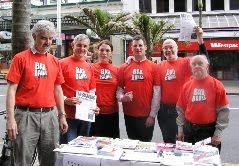
The first goal of the Bad Banks campaign is to educate people about the operations of the banks. Bad Banks activists will be out on the streets in Auckland and other cities handing out leaflets and talking to people over the coming weeks and months.
“People can find out more about Bad Banks by going to our webpage www.badbanks.co.nz. We welcome any stories or comments on the banks,” says Gunson. “We’re looking to reach out to other groups, organisations and individuals to help build this campaign.”
2 September 2009
The operations of the Big Four Aussie-owned banks are harmful to the lives of ordinary Kiwis,” says Vaughan Gunson, publicity coordinator for Bad Banks, a recently initiated grassroots campaign against banking power.
ANZ National Bank, BNZ, Westpac and ASB have been making mega-profits from interest gouging grassroots Kiwis. In 2008, their combined income from loan interest went up $4.6 billion. Last year the profits of the Big Four totaled over $3 billion.
“And now, in a recession, these Bad Banks are king-hitting people who have lost their jobs or had their incomes cut,” says Gunson. “They’re inflicting penalties on people who can’t meet their mortgage payments and forcing mortgagee sales in increasing numbers.”
“They’re looking after their own equity position and chucking people out of their homes. It’s disgusting. These Bad Banks are part of a corporate culture of greed that’s sucking the life out of this country,” says Gunson.
While it's good that the Green, Labour and Progressive parties have gone ahead with their banking inquiry, the time frame for submissions was very short. That means there are only 11 oral submissions.
“11 oral submissions does not do justice to the devastating impact banking power is having on the lives of grassroots Kiwis,” says Gunson. “We need a full public inquiry, properly resourced and promoted, so that grassroots people can have their say and the Aussie-owned banks be held to account.”
“Any full public inquiry should allow for public meetings up and down the country, so that grassroots people can tell their stories.”
“We hope that MPs in the Green, Labour and Progressive parties are going to be part of an ongoing campaign against the banks,” says Gunson. “We need to confront corporate power full-on.”
The first goal of the Bad Banks campaign is to educate people about the operations of the banks. Bad Banks activists will be out on the streets in Auckland and other cities handing out leaflets and talking to people over the coming weeks and months.
“People can find out more about Bad Banks by going to our webpage www.badbanks.co.nz. We welcome any stories or comments on the banks,” says Gunson. “We’re looking to reach out to other groups, organisations and individuals to help build this campaign.”
Subscribe to:
Posts (Atom)



 Posts
Posts

