by Ruth Sunderlund
from The Observer
22 December 2009
It's fortunate for a number of reasons that the British Airways cabin crew strike has been averted - not least because disenchanted London bankers can head for Heathrow airport right now, if that's what they really want.
The argument that banks and bankers are highly mobile and would leave London if provoked is endlessly deployed to defend bonuses, but it is not interrogated nearly enough. Now Andy Haldane, the Bank of England's head of financial stability, has called the bankers' bluff. He is on safe ground to suppose there will not be overspill in the departure lounge.
Hedge funds and small financial outfits might be reasonably footloose, but big banks are much less so. And where would the refugee bankers, fleeing cruel persecution in Britain, find sanctuary? If they really want to turn their backs on advantages such as the English language, the favourable time zone, the world-class cultural life and the honeypot of business services in London, they would have to find a jurisdiction prepared to underwrite their activities.
Tax havens such as the Cayman Islands have been overbalanced by the credit crunch and would not be capable of doing so. Traditional magnets such as Switzerland are stretched to breaking point by supporting their existing banks - they would not want to take on responsibility for any more. And why would the US, or China, contemplate burdening their taxpayers with institutions that define themselves as too buccaneering for Britain?
I'm not sure what the optimal size of the financial sector is, but given that taxpayer bailouts are an integral feature of the industry, occurring periodically and costing more each time, it is not in the least obvious that bigger is better. Proportionately, public sector interventions in Britain during the financial crisis were much larger than in the US or the euro area, reaching more than 70 per cent of GDP this year.
The problem with relying so heavily on financial services is that we are hanging our national fortunes on a sector that is potentially very lucrative, but also ruinously risky.
Health, not size, is key.
Haldane's comments are not only interesting in themselves, but because they appear to be a harbinger of a tougher stance. The Bank of England's latest financial stability report urges the banks to replenish their capital now, while the sun is, if not shining brightly, at least casting a few wintry rays.
It wants to see them start a virtuous circle, by retaining more capital instead of paying bonuses and dividends. That would send down the cost of funds, which in turn would get credit flowing through the economy. Non-financial companies would then perform better, resulting in lower loan losses for banks.
In the long term, everybody's happy. In the short term, bank shareholders will squeal - share prices have already fallen in response to the Chancellor Alistair Darling's bonus tax - and the bonus lobby will cry that it is infringing their basic human right to the moolah.
The bank's exhortations come against a background of international reform. The Basel committee on banking supervision is suggesting a series of measures, including proposals that would limit the ability of banks to pay bonuses and dividends if their capital dropped close to the minimum required.
The system looks more stable and more resilient than it did six months ago, but there is a very difficult road ahead. Next year, we can expect progress on an international level on improving the regulation of capital and liquidity.
It will take longer to resolve two parallel debates: The first is around dynamic provisioning - or whether central banks can let the air out of bubbles before they burst, by insisting that banks build up cushions of capital in the good times to soften their landings in the bad. The second is about firms that are too big to fail - how they can be wound up with the least possible damage, and whether there should be a separation of utility banking from the casino variety as I have advocated, and far more importantly, as has the bank's governor, Mervyn King.
People are calling this an "ice age" for bankers, but it is blatantly premature for them to be receiving bonuses off the back of free money injected by central banks, at a time when there are still enormous risks.
Some individual households are very highly leveraged and vulnerable to a rise in interest rates. Potentially bad loans in the commercial property sector are looming like a black cloud: £160 billion ($364 billion) of loans are due to be refinanced by 2013. So far, we have only had a liquidity crisis - the real credit crisis is yet to happen.
Showing posts with label bonuses. Show all posts
Showing posts with label bonuses. Show all posts

6.12.09
Pay for bank bosses needs to be regulated
As the article below argues extreme levels of pay, topped up with obscene bonuses, are a factor in the banks taking extreme lending risks. Individuals within individual banks chasing "big bonuses" in competition with other banks has played its part in driving forward the expansion of credit to unsustainable levels, threatening the stability and continuation of the global market economy.
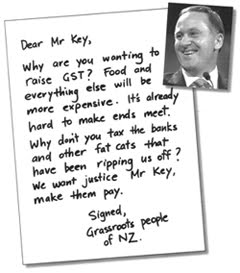
Any movement looking to curb banking power needs to include the demands for government regulation of bankers' salaries and bonuses. This demand would be popular with grassroots people wanting to see the banks brough into line.
Any movement looking to curb banking power needs to include the demands for government regulation of bankers' salaries and bonuses. This demand would be popular with grassroots people wanting to see the banks brough into line.
Bankers had cashed in before the music stopped
by Lucian Bebchuk, Alma Cohen and Holger Spamann
from Financial Times (UK)
6 December 2009
According to the standard narrative, the meltdown of Bear Stearns and Lehman Brothers largely wiped out the wealth of their top executives. Many – in the media, academia and the financial sector – have used this account to dismiss the view that pay structures caused excessive risk-taking and that reforming such structures is important. That standard narrative, however, turns out to be incorrect.
It is true that the top executives at both banks suffered significant losses on shares they held when their companies collapsed. But our analysis, using data from Securities and Exchange Commission filings, shows the banks’ top five executives had cashed out such large amounts since the beginning of this decade that, even after the losses, their net pay-offs during this period were substantially positive.
In 2000-07, the top five executives at Bear and Lehman pocketed cash bonuses exceeding $300m and $150m respectively (adjusted to 2009 dollars). Although the financial results on which bonus payments were based were sharply reversed in 2008, pay arrangements allowed executives to keep past bonuses.
Furthermore, executives regularly took large amounts of money off the table by unloading shares and options. Overall, in 2000-08 the top-five teams at Bear and Lehman cashed out close to $2bn in this way: about $1.1bn at Bear and $850m at Lehman. Indeed, the teams sold more shares during the years preceding the firms’ collapse than they held when the music stopped in 2008.
Altogether, equity sales and bonuses over that period provided the top five at the two banks with cash of about $1.4bn and $1bn respectively (an average of almost $250m each). These cash proceeds considerably exceed the value of the executives’ holdings at the beginning of 2000 (which we estimate to be in the order of a respective $800m and $600m).
Of course, the executives would have made much more had the banks not blown up. By contrast to shareholders who stuck with the banks, however, the executives’ total pay-offs during the period were decidedly in the black.
Our analysis undermines the claims that executives’ losses on shares during the collapses establish that they did not have incentives to take excessive risks. The fact that the executives did not sell all the shares they could prior to the meltdown does indicate that they did not anticipate collapse in the near future. But repeatedly cashing in large amounts of performance-based compensation based on short-term results did provide perverse incentives – incentives to improve short-term results even at the cost of an excessive rise in the risk of large losses at some (uncertain) point in the future.
To be sure, executives’ risk-taking might have been driven by a failure to recognise risks or by excessive optimism, and thus would have taken place even in the absence of these incentives. But given the structure of executive pay, the possibility that risk-taking was influenced by these incentives should be taken seriously.
The need to reform pay structures is not, as many have claimed, simply a politically convenient sideshow. Even if the type of incentives given to executives of Bear and Lehman – and others with similar pay structures – were not the cause of risk-taking in the past, they could be in future. Financial institutions, and the regulators overseeing them, should give the necessary priority to redesigning bonuses and equity-based compensation to avoid rewarding executives for short-term results that are subsequently reversed.
The stories of Lehman and Bear will undoubtedly remain in the annals of financial disaster for decades to come. To understand what has happened, and what lessons should be drawn, it is important to get the facts right. In contrast to what has been thus far largely assumed, the executives were richly rewarded for, not financially devastated by, their leadership of their banks during this decade.
Subscribe to:
Posts (Atom)




 Posts
Posts

