Showing posts with label global economic crisis. Show all posts

12.5.10

Activists send message to Key: “Make the banks pay!”

Bad Banks media release
13 May 2010

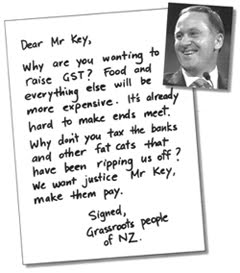
Prominent New Zealand activists and unionists are among the 53 public signatories to a letter to prime minister John Key calling for action to curb banking power and protect grassroots people. The full list of public signatories is included below.

The letter, written on behalf of grassroots people in New Zealand, reads:

Dear Mr Key,

Why are you wanting to raise GST? Food and everything else will be more expensive. It's already hard to make ends meet. Why don't you tax the banks and other fat cats that have been ripping us off? We want justice Mr Key, make them pay.

Signed,
Grassroots people of NZ

“The global financial crisis has inflicted a lot of pain on New Zealanders, with job losses and widespread clamps on wages,” says Vaughan Gunson, Bad Banks spokesperson. “And this pain is being compounded by the Big Four Aussie banks looking after their own equity position. They’ve been forcing mortgagee sales and inflicting penalties on homeowners struggling to meet their mortgage payments.”

“We're sending a message to John Key and the government: it's the banks and other financial fats cats who must be made to pay, not grassroots New Zealanders," says Gunson.

With the letter Bad Banks campaigners are proposing three "common sense" measures that would rein in the banks and deliver real benefits to grassroots people. The three measures are:

1. Stop forced mortgagee sales
Regulatory muscle used to stop banks turfing people out of their homes. A government body to oversee the re-negotiation of mortgages based on current market values and ability of the homeowner to pay.

2. Turn Kiwibank into a proper public bank
Offering 3% interest loans to first home buyers, zero-fee banking for people on modest incomes, and low interest loans to local bodies for sustainable eco-projects in the public good.

3. Introduce a Robin Hood Tax (also known as a Financial Transaction Tax)
A small percentage tax on financial transactions would net billions of dollars from banks and global financial speculators. GST could be phased out.

“We’re inviting New Zealanders to sign on to the letter and support these three demands,” says Gunson. "They're doable, if there's the political will."

People can add their name online by visiting the Bad Banks website www.badbanks.co.nz, or by going directly to http://www.ipetitions.com/petition/badbanks/. People can also make a comment if they wish.

“In a month’s time we’ll be formally forwarding the letter and the full list of people who’ve signed, plus their comments, to the prime minister,” says Gunson.

“We would like to see a debate in New Zealand about why the government is planning to lift GST to 15% in the Budget on 20 May, while the big banks are being allowed to continue making their mega-profits,” says Gunson. “Bad Banks campaigners are up for the debate – is Mr Key?"

See also Bad Banks media release (25 April), Something missing from GST debate: a Robin Hood Tax.

A higher resolution image of the attached graphic for use in print and online publications is available.

For more information and comment, contact

Vaughan Gunson
Bad Banks spokesperson
svpl(at)xtra.co.nz
(09)433 8897
021-0415 082


The 53 public signatories to the letter to Mr Key and the accompanying proposals to rein in the banks and protect grassroots people are:

Moea Armstrong, co-convenor Green Party of Aotearoa/NZ, Whangarei.

James Barber, male co-convenor Greens@Vic, Wellington.

Potaua Biasiny-Tule, TangataWhenua.com, Rotorua.

Nikolasa Biasiny-Tule, TangataWhenua.com, Rotorua.

Victor Billot, communications officer Maritime Union, Dunedin.

Pat Bolster, secretary Unions Wellington.

Sue Bradford, community activist, Auckland.

Grant Brookes, union delegate, Wellington.

Paul Bruce, Greater Wellington Regional Councillor.

Andrew Campbell, union organiser, Wellington.

Joe Carolan, campaigns officer Unite Union & editor SocialistAotearoa.org

Laurence Clark, cartoonist & journalist, Whangarei.

David Colyer, editor UNITYblog, on-line journal of Socialist Worker-New Zealand.

Catherine Delahunty, Green Party List MP, Coromandel Peninsula.

Vincent Eastwood, Guerilla Media, Auckland.

Aaron Edwards, organiser Green Party, Whangarei.

Tony Fala, community worker, Manukau City.

Joe Fleetwood
, general secretary Maritime Union of New Zealand, Wellington.

Quentin Findlay, economic development spokesperson Alliance Party, Christchurch.

Roger Fowler, manager Mangere East Community Learning Centre, Auckland.

Rob George, convenor Unions Waikato, Hamilton.

Vaughan Gunson, spokesperson Bad Banks & national chair Socialist Worker-New Zealand, Whangarei.

Omar Hamed, organiser Unite Union, Wellington.

Bernie Hornfeck, chairperson Rotorua Peoples’ Union.

Murray Horton, secretary/organiser for CAFCA (Campaign Against Foreign Control of Aotearoa), Christchurch.

Tim Howard, community worker, Whangarei.

Peter Hughes, union organiser, Auckland.

Prue Hyman, feminist economist Victoria University, Wellington.

Nik Janiurek, theatre lighting designer, Auckland.

Shafqat Kadri, student MA Applied Language Studies, University of Auckland.

Sydney Keepa, National Distribution Union Apiha Maori & co-convener Kaimahi Maori CTU Runanga,

Daphne Lawless, musician & writer, Auckland.

Dion Martin, organiser National Distribution Union, Palmerston North.

Paul Maunder, writer & community worker.

Matt McCarten, general secretary Unite Union, Auckland.

William (Billy) Mckee, director GreenCross NZ, Levin.

John Minto, community activist, Auckland.

Grant Morgan, international secretary Socialist Worker-New Zealand, Auckland.

Pat O'Dea, electrician & union activist, Auckland.

Hana el Ojeili, student LLB University of Auckland.

Dean Parker, NZ Writers' Guild, Auckland.

Len Parker, manager Socialist Centre, Auckland.

Kristy Pearson, student activist, Dunedin.

Paul Piesse, president Alliance Party, Christchurch.

Robert Popata, organiser Kotahitanga Union, Whangarei.

John Ryall, national secretary Service & Food Workers Union Nga Ringa Tota, Wellington.

Ross Scholes, Democracy activist, Auckland.

Tony Snelling-Berg, Socialist Worker activist, Tauranga.

Fran Strajnar, business owner, Auckland.

Owen Thompson, Unite Union, Auckland.

Mike Treen, national director Unite Union, Auckland.

Sarah Watson, writer & teacher, Wellington.

Oliver Woods, advertising manager, resident Singapore.

*All public signatories do so as individuals, with their positions or brief descriptors included for identification purposes.

**We welcome more community campaigners and prominent people becoming public signatories prior to the letter and accompanying demands being formally sent to the prime minister. Contact Vaughan, email svpl@xtra.co.nz or ph/txt 021-0415 082.

11.1.10

Iceland: People power rises against financial overlords

The people of Iceland are saying no to having the cost of the financial crisis dumped on them. A quarter of Iceland's voters have signed a petition rejecting a deal which would see Iceland, through an IMF loan, pay billions to overseas creditors who lost money when the Icelandic banks went belly-up following the global financial crisis. The deal was the result of pressure from the British and Dutch governments in support of their banking class, who had a major hand in the high risk profiteering of Iceland's banks prior to the crisis.

While the situation in Iceland is at an extreme, it shows that it's possible for people to mobilise against the kings of capital and the governments that act to protect the interests of the mega-rich. With no real change in the way the big global banks and financial institutions are operating, and with the world economy having an ever increasing debt overhang, it is inevitable that more countries will be thrown into extreme economic and political crisis. In New Zealand, we need to prepare for such an event by building a broad and multi-headed campaign against the banks and neo-liberalism. To join the Bad Banks campaign email Vaughan svpl(at)xtra.co.nz

Angry Iceland Defies the World

by Ambrose Evans-Pritchard
from Telegraph
6 January 2010

Iceland's president has blocked a Bill to pay Britain and Holland up to £3.4bn for Icesave depositors, acknowledging that popular feeling in the island nation is too strong to proceed without a referendum. 


The move reopens a bitter dispute and greatly complicates Iceland's loan agreement with the International Monetary Fund. It has already led to a fresh downgrade to BB+ by Fitch Ratings, which called the decision "a significant setback to Iceland's efforts to restore normal financial relations with the rest of the world."

The Icesave law was passed by Iceland's parliament in a knife-edge vote late last year, but a petition by the InDefense movement has changed the political landscape. The lobby collected 56,000 signatures – a quarter of voters.


President Olafur Ragnar Grimsson said the "overwhelming majority" wanted a direct say over the matter, and that no settlement would hold without their assent.

"It is the cornerstone of the constitutional structure of the Republic of Iceland that the people are the supreme judge of the validity of the law," he said. "At this crucial juncture it is also important to emphasise that the recovery of the Icelandic economy is a matter of vital urgency".

If voters say "No" when the referendum takes place in a couple of months, the accord thrashed out with London and the Hague during months of wrangling will no longer have any credibility, whatever the legal niceties.

The reality is that Icelanders have erupted in collective rage at what they believe to be gross injustice and "gunboat diplomacy" by Downing Street. What rankles is Britain's use of anti-terrorism law to freeze Iceland's assets. The Icelandic central bank was listed besides al-Qaeda as a terrorist body – unprecedented treatment for a NATO ally. Holland was careful not to go so far.

"Importers couldn't get trade finance for food. We feel deeply wronged," said Johannes Skulason from InDefence. Shelves were bare for weeks in Icelandic shops as the banking system disintegrated.

Einars Már Gudmundsson, a novelist, said most citizens were unaware that Iceland's three leading banks –Landsbanki, Glitnir and Kaupthing – were operating as global hedge funds with exposure of 11 times Iceland's GDP.

"I had never heard of Icesave till this happened," said Mr Gudmundsson. "We were told that what these banks did abroad was nothing to do with us but when it all went wrong the responsibility fell back on us. Profits were privatised, but losses were nationalised."

He added: "We're told if we reject the terms, we will be the Cuba of the North. But if we accept, we'll be the Haiti of the North."

Both Britain and Holland expect Iceland to stick to its agreement, but the legal claims are far from watertight. Iceland accepted "political responsibility" for the 320,000 British and Dutch deposits in exchange for lenient terms (arguably denied) in November 2008, but never accepted the legal claim.

The UK has refunded private savers up to £50,000, but councils such as Kent are relying on the deal to recoup their money. They have retrieved £100m of the £900m put in Icelandic accounts.

Iceland's Left-wing coalition – which unseated free marketeers in February's "Saucepan Revolution" – has backed the Icesave terms, deeming it is the only way for Iceland to move beyond the disastrous episode. The petitioners said they accept that Iceland's people should foot part of the bill, but object to the "Versailles" terms: a loan at 5.55pc interest, to be repaid within 15 years. The central banks said this will increase Iceland's public debt by 20pc of GDP.

A report by Sweden's Riksbank said Britain and Europe share blame for the fiasco. It said "absurd" EU rules – which cover Iceland indirectly – told states to set up a "guarantee scheme" for banks, but never said taxpayers were liable for losses.

The reports added that the UK "hardly bothered" to inform savers that the schemes were ill-funded. "The conclusion is clear: the EU host countries (UK and Holland) are also to blame for Iceland's disaster. It would be reasonable that they carry some of the burden. It takes two to tango," it said.

The UK Financial Services Authority said it was unable to stop Icelandic banks raising deposits in the UK under the EU's "passport" system, even when they began milking UK customers to cover losses at home.

Whatever the rights and wrongs, Iceland was by then already being crushed by a financial tsunami. Britain's use of anti-terror laws at that moment will not sit pretty in diplomatic history.

23.12.09

“Time to hit the banks and international speculators with a Financial Transaction Tax”, say Bad Banks campaigners.

Bad Banks media release
24 December 2009

“It’s great news that the Aussie-owned banks have to pay up their unpaid tax,” says Vaughan Gunson, Bad Banks campaign manager. “It’s a defeat for them.” [See NZ Herald article Banks to pay taxman billions]

“It shows that big corporations can be brought into line. While the IRD had the law on its side, we shouldn’t underestimate the role mass public opinion has played in getting the banks to cough up,” says Gunson.

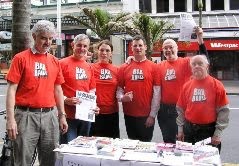
Bad Banks campaigners have been on the streets over the last few months handing out leaflets with information on the banks and the world economic crisis. “We’ve found there’s a real bad mood against the banks,” says Gunson.

“People know the Aussie banks have been making exorbitant profits over the last decade by charging high interest rates for mortgages and credit cards, high fees, and through mega-scale tax avoidance,” says Gunson.

People have been telling us, “Yes, the banks are bad”, “They’re ripping us off big time”, “The banks want to turn us all into debt slaves”.

“And there’s a high level of awareness that it’s the global banking cartels who are responsible for the world economic crisis which is causing large-scale job losses in New Zealand, along with widespread clamps on wages and salaries,” says Gunson.

“The banks and other corporates are trying to make ordinary working people bear the cost of the crisis. We need to resist,” says Gunson.

“To make the big banks and financial speculators pay we’re campaigning for the introduction of a Financial Transaction Tax. A small percentage tax on every financial transaction would net hundreds of millions from banks and international speculators who shift billions and billions of dollars around every year,” says Gunson.

“A tax that targets the mega-rich would allow us to shift the tax burden off low and middle income earners,” says Gunson. “We could take GST off food, which would be a big help to grassroots New Zealanders struggling to pay the bills.”

“Just because the banks have been forced to pay their unpaid tax bill, doesn’t mean they should be let of the hook,” says Gunson. “To protect our people we urgently need major reform of the banking industry.”

To contribute to the national debate that we must have in New Zealand about the banking system, Bad Banks offers these suggestions for transforming the power relationship between banks and the people:

1. Immediate government intervention to stop banks chucking "mum and dad" homeowners out of their homes because of a job loss or income cut.

2. The establishment of a government regulatory body to oversee the renegotiation of mortgages based on realistic market values and the ability of the homeowner to pay.

3. Turn Kiwibank into a proper "public service" bank offering first-home buyers a 3% interest state loan.

4. Zero-fee banking offered to people on modest incomes. Facilitated by expanding the role of Kiwibank and forced regulation of all banks operating in New Zealand .

5. Introduction of a Financial Transaction Tax (FTT) that would net the banks and other financial speculators. A decisive step in shifting the tax burden off low and middle income people and onto the mega-rich.

6. All bank loans to big business over a fixed amount to be approved by a government regulatory body that acts to protect the environment and communities. Such a measure is essential to preventing powerful global banking interests from sabotaging the necessary emergency mobilisation against climate change.

7. A full public inquiry which looks at every aspect of banking operations in New Zealand , with public meetings held throughout the country, so that grassroots people can tell their stories.

For more comment, contact:

Vaughan Gunson
Bad Banks campaign manager
(09)433 8897
021-0415 082
svpl@xtra.co.nz


See also the media release from CAFCA, IRD Delivers Best Possible Xmas Present To Long Suffering Kiwi Taxpayers.


Société Générale Predicts Global Economic Collapse In Two Years Time

by Ambrose Evans-Pritchard
22 December 2009
from Telegraph.co.uk

Société Générale has advised clients to be ready for a possible "global economic collapse" over the next two years, mapping a strategy of defensive investments to avoid wealth destruction.

In a report entitled "Worst-case debt scenario", the bank's asset team said state rescue packages over the last year have merely transferred private liabilities onto sagging sovereign shoulders, creating a fresh set of problems.

Overall debt is still far too high in almost all rich economies as a share of GDP (350pc in the US), whether public or private. It must be reduced by the hard slog of "deleveraging", for years.

"As yet, nobody can say with any certainty whether we have in fact escaped the prospect of a global economic collapse," said the 68-page report, headed by asset chief Daniel Fermon. It is an exploration of the dangers, not a forecast.

Under the French bank's "Bear Case" scenario (the gloomiest of three possible outcomes), the dollar would slide further and global equities would retest the March lows. Property prices would tumble again. Oil would fall back to $50 in 2010.

Governments have already shot their fiscal bolts. Even without fresh spending, public debt would explode within two years to 105pc of GDP in the UK, 125pc in the US and the eurozone, and 270pc in Japan. Worldwide state debt would reach $45 trillion, up two-and-a-half times in a decade.

(UK figures look low because debt started from a low base. Mr Ferman said the UK would converge with Europe at 130pc of GDP by 2015 under the bear case).

The underlying debt burden is greater than it was after the Second World War, when nominal levels looked similar. Ageing populations will make it harder to erode debt through growth. "High public debt looks entirely unsustainable in the long run. We have almost reached a point of no return for government debt," it said.

Inflating debt away might be seen by some governments as a lesser of evils.

If so, gold would go "up, and up, and up" as the only safe haven from fiat paper money. Private debt is also crippling. Even if the US savings rate stabilises at 7pc, and all of it is used to pay down debt, it will still take nine years for households to reduce debt/income ratios to the safe levels of the 1980s.

The bank said the current crisis displays "compelling similarities" with Japan during its Lost Decade (or two), with a big difference: Japan was able to stay afloat by exporting into a robust global economy and by letting the yen fall. It is not possible for half the world to pursue this strategy at the same time.

SocGen advises bears to sell the dollar and to "short" cyclical equities such as technology, auto, and travel to avoid being caught in the "inherent deflationary spiral". Emerging markets would not be spared. Paradoxically, they are more leveraged to the US growth than Wall Street itself. Farm commodities would hold up well, led by sugar.

Mr Fermon said junk bonds would lose 31pc of their value in 2010 alone. However, sovereign bonds would "generate turbo-charged returns" mimicking the secular slide in yields seen in Japan as the slump ground on. At one point Japan's 10-year yield dropped to 0.40pc. The Fed would hold down yields by purchasing more bonds. The European Central Bank would do less, for political reasons.

SocGen's case for buying sovereign bonds is controversial. A number of funds doubt whether the Japan scenario will be repeated, not least because Tokyo itself may be on the cusp of a debt compound crisis.

Mr Fermon said his report had electrified clients on both sides of the Atlantic. "Everybody wants to know what the impact will be. A lot of hedge funds and bankers are worried," he said.

24.9.09

BAD BANKS: Targeting late capitalism's exploitation of labour and nature

by GRANT MORGAN
Socialist Worker-New Zealand

World capitalism's boosters, led by US Federal Reserve chair Ben Bernanke, are welcoming economic "green shoots" and proclaiming "the end of recession".

Nobody has a crystal ball, and yes, at some stage the global economy will start to recover, even if only partially and temporarily. But we need to look at the bigger picture if we are to have any idea of what might lie ahead.

SHARE MARKET BUBBLE

At present, the economic "recovery" is first and foremost a recovery in share market prices, while global unemployment continues to rise and real wages are being driven down.

The levels of unemployment and wages are a much safer way to assess the real state of the real economy than share market fluctuations. What we are now seeing is a share market bubble disconnected from rising unemployment and falling real wages.

Late capitalism increasingly depends on financial and asset bubbles which are disconnected from the real economy.

PROFITABILITY CRISIS

Obviously, that means financial and economic instability is going to be not only more endemic than during early or middle capitalism, but also more catastrophic in its effects. That we saw during the Great Implosion of September 2008 which came close to collapsing the world system's financial structures.

Late capitalism's increasing dependency on financial and asset bubbles is a key symptom of something deeper. The world system is finding it much harder to translate the mega-accumulation of capital into the maximised profit margins which alone can sustain the global rule of ever fewer monopolists.

Many analysts have pointed to the increasing disconnect between rising labour productivity and falling consumer demand, leaving the world economy awash with unwanted consumer goods and excess productive capacity. That is an obvious driver of the world system's profitability crisis.

REVENGE OF NATURE

But there are other drivers as well. Hand-in-hand with the exploitation of labour, the exploitation of nature is creating an existential gulf between human sustainability and corporate profitability.

Since its birth 500 years ago, capitalism has been dependent on the free lunches provided by labour and nature. Without the state-sanctioned looting of nature, the world system could not meet its profit needs, any more than it could without the state-sanctioned wage slavery of workers.

Now we are seeing the revenge of nature, most notably in the rising tides of global warming, but also in the resource depletion and chain-reaction pollution which will intersect with climate change in dangerously unpredictable ways.

TERMINAL CANCERS

Unless checked by a global mobilisation, climate change will kill millions and perhaps billions of people on the planet, unleashing a mega-crisis which kills capitalism. Yet any such global mobilisation will fatally undermine corporate profitability and thus kill capitalism anyway, maybe even quicker.

Late capitalism is being eaten away by terminal cancers.

Yet we cannot simply stand by and wait for something better. The elites who run late capitalism will stop at nothing to transfer their power and privileges to a post-capitalist world which is almost certain to be even more barbaric. That is the road to a mass die-back of humanity and other life forms.

MANY GOOD CAUSES

So the question is: what can we do, right here and right now, to prepare the ground for a post-capitalist world which is more democratic, more equitable and more ecological than the present system.

There is no single or simple answer to that question. The struggles of many leftists in many countries around many causes all help, cumulatively, to make the grassroots stronger and the elites weaker.

Among the good causes that New Zealand leftists are currently promoting are the living wage, climate justice and pro-MMP campaigns.

ASYMMETRIC WARFARE

There exists a vital need to shape all such campaigns into a sharper challenge to the world system which creates the evils that necessitate the campaigns in the first place. Otherwise we are forever fighting the symptoms, leaving the system's elites far too much leeway to perpetuate themselves.

Yet any call to "fight capitalism" would lack mass appeal because it's too distant from most people's consciousness and capabilities.

How then can we proceed? The fundamental principle of asymmetric warfare, where the weak confront the strong, is to strike wherever the enemy is most exposed and wherever the most damage can be inflicted.

WIDESPREAD PUBLIC HOSTILITY

The big banks, whose colossal investments shape the very structures of all economies and, therefore, their governing politics and ideologies, are already the object of widespread public hostility.

If we direct our fire against the big banks, and get a good public response, then late capitalism will be weakened at an increasingly vulnerable yet important spot: the financialisation of the world system.

That is the strategic objective of Socialist Worker's Bad Banks campaign, launched in Auckland not long ago. It is an objective in harmony with the fundamental principle of asymmetric warfare.

WIDESPREAD PUBLIC SUPPORT

The Bad Banks campaign targets the key investment drivers who are responsible for rising unemployment, falling real wages, climate change and other evils flowing from capitalism's exploitation of labour and nature.

It is therefore a campaign which fingers the causes as well as the consequences of the evils of late capitalism. And going by early results at Bad Banks street stalls, there is widespread public support for the campaign.

To help out at a Bad Banks stall, email socialist-worker@pl.net.

4.9.09

Mega-rich bankers are squeezing the world

Text from the back page of Bad Banks leaflet #1.

The cartoon (above) shows a “fat cat” sitting on people. It’s a comical image. Unfortunately it shows a sad truth. Around the world today this is what’s happening to grassroots people like us.

The fallout from the global economic crisis is leading to millions losing their jobs. In the US, the world’s biggest economy, 1 in 6 workers are out of work. 50% of homeowners risk losing their homes.

As economies slump governments are cutting spending on health, education and other services, making things worse for grassroots people.

But while this is going on, trillions of dollars have been raised to bailout banks and other financial institutions, the very ones behind the meltdown.

Big banks, like the US based Goldman Sachs, exert enormous influence over markets. They helped inflate the global “housing bubble”.

Grassroots people all over the world got caught up in the house price spike, forced to take out big loans to buy a home. The banks, media and politicians told us it was OK. House prices, they said, would continue to rise and we’d all be better off.

This was a lie, one the banks, media and politicians were happy to peddle because all this borrowing was making a few people super-rich.

But it couldn’t last, the wages of ordinary people weren’t going up in line with house prices. It all came unstuck in 2007 when house prices in the US and elsewhere fell and indebted homeowners began defaulting on their mortgages. This caught out most of the world’s banks who all had a finger in the “housing bubble” pie.

With trillions of dollars of “bad debt” on their books the banks stopped lending. Because so much of today’s economy is founded on borrowing (by governments, business and ordinary people) to have credit freeze up was a nightmare scenario for the Kings of Capital.

To keep the profits flowing governments wrote blank cheques for the banks. A recent report calculated that the bailout figure for the US alone is expected to climb to $23.7 trillion!

The global economy, however, is still nose-diving, leading to a pandemic of job losses.

Yet out of this social misery many of the big banks are returning to profitability. Goldman Sachs is posting record profits. These mega-rich bankers are set on dominating like never before the creation of credit. They’re lending to cash-strapped governments at high interest rates. They’re speculating again in financial markets. It’s “win-win” for them and “lose-lose” for us.

A system that can divert trillions of dollars to a mega-rich minority and let the majority fend for themselves is an unjust one. The fat cats are sitting on top of us. And that has to be changed. The Bad Banks campaign is where it starts.

25.8.09

Why we need to battle the banks

by Vaughan Gunson

The recession is taking grip in New Zealand. People are losing their jobs. In some grassroots communities unemployment is already turning into a social crisis.

138,000 people are officially unemployed. Thousands more will be desperately looking for work. And the situation is going to get grimmer as the economy slumps further.

Job losses and income cuts are putting many homeowners in a terrible situation. They can’t meet their mortgage payments. The banks are knocking at the door.

And with property values falling some people are left owing more money to the banks than their home is worth. They face financial ruin.

For grassroots people, this is all very frightening and unfair.

Grassroots mood against the banks

Jobs and homes are gut issues for people. Rising concern about these gut issues is intersecting with a mass mood against the banks.

Last year, RAM activists took a survey out on to the streets, which questioned people about the operations of the banks in this country. Over 90% of people thought the banks were doing no good.

That sentiment has probably hardened. It can be picked up in everyday conversations. It’s reflected in the stories being carried in the media.

You know there’s a mass mood on an issue in New Zealand when two things happen. The first is when it becomes a storyline on Shortland Street. Scotty and Shanti are in trouble with the bank, owing more than their house is worth.

The second indicator of a mass mood is when you start hearing calls for a public enquiry.

This is what the Green, Labour and Progressive parties have been voicing. They want an independent public enquiry into the banks. They’ve sensed the mood and the political opportunities that it presents.

Not right

In the eyes of grassroots people it’s not right that in these times of increasing hardship the banks are continuing their profit run.

The Big Four Australian-owned banks, ANZ National Bank, BNZ, Westpac and ASB, control 90% of the banking industry in New Zealand, putting them in a near-monopoly position.

With so much market control, there’s no pressure to lower interest rates. In 2008, the income the Big Four banks received from loan interest went up a whopping $4.6 million.

As a result the profits of these Aussie-owned banks totalled over $3 billion in 2008, up 3.7% on the year before.

To add fuel to the fire, the Big Four are trying to avoid paying a tax bill of $2.25 billion. BNZ has been convicted by the High Court and told to pay up. Undaunted, the banks are using their extreme wealth to hire teams of lawyers to fight the ruling.

The feelings people have towards the banks has been heading South for sometime. This was before the banks started turfing people out of their homes.

To maintain their own equity position the banks are getting tough and forcing mortgage sales in rapidly increasing numbers. In April this year, there were 250 foreclosures. The numbers are only going to escalate as mortgage pressures worsen with further waves of job losses.

The banks are the bad guys. They could become public enemy number one.

A Bad Banks campaign

In isolation grassroots people have no power against the banks and the laws written to protect the money men. But mass feelings are strong.

It is the job of mass Marxists to tap into those mass feelings. That’s why Socialist Worker is launching a “Bad Banks” campaign.

We believe the Aussie banks are vulnerable to a broad and inclusive campaign that connects with the anger ordinary people feel towards these mega-rich interest gauges.

A campaign to expose and shame the banks must be out on the streets. We’ll produce mass leaflets and posters. There will be street stalls. We can build towards publicity pickets outside targeted banks.

We will organise public meetings. Send out media releases, write submissions. We will liaise with others on the left about organising jointly hosted campaign conventions.

The campaign will have a web presence (www.badbanks.co.nz). A Bad Banks Facebook group is up and running (log into Facebook and search for “Bad Banks”).

We will pursue multiple publicity strands that aim to connect with masses of grassroots people.

The first stage of the campaign will be educative. We’ll tell people what the banks are up to. We’ll even explain in popular language “fractional reserve lending”, the credit creation mechanism which literally allows the banks to make money out of thin air.

Our leaflets and other publicity will connect the operations of the banks to the Great Implosion. Explaining what’s happening globally and pointing the finger at who’s responsible. Knowledge, as they say, is the first step to empowerment.

As the Bad Banks campaign evolves we begin to put forward concrete demands and campaign goals. These will emerge through dialogue with other leftists and through listening to grassroots people themselves.

Broad left cooperation

A multi-headed campaign against the banks has the potential to bring networks of indebted homeowners, political parties, unions, community groups and grassroots activists together.

The campaign on the streets should work in tandem with the good initiative of the Green, Labour and Progressive parties to set up their own independent public enquiry into the banks. Parliamentary and street campaigning can both work to build a movement. Linking these two essential political arenas will get the best out of each.

The Bad Banks campaign (or some other campaign name that emerges through discussions with others) could become an invigorating example of broad left political cooperation in practice. This would be extremely positive.

Joint work, sharing of ideas and on-the-ground collective organisation around this “flashpoint” political issue will hopefully encourage a further coming together of broad left forces. Such political cooperation is needed if the left is to rise to the challenge of the biggest economic meltdown since the Great Depression of the 1930s.

Banks and the “bubble economy”

The role the banks and international money men have played in the Great Implosion needs to be widely exposed. The banks are at the centre of the “bubble economy” built on trillions of dollars of debt and speculation.

The floundering of the real economy since the 1970s has seen workers, business and the state increasingly reliant on the extension of credit.

Over the last four decades debt has ballooned. This has allowed the banks and other money lenders, facilitated by governments, to assume a dynamic role within late capitalism.

So entwined are industry giants, big banks and governments, that when the credit crunch hit last year, following the bursting of the worldwide housing bubble, the leaders of the world’s big economies raced to save the banks.

In January this year, Oxfam calculated that $8.424 trillion had so far been raised by governments to bailout the banks and other financial institutions. That’s a vast sum, one which could easily put an end to world poverty.

And the bailouts haven’t stopped. In the US alone, the Obama administration’s bailout commitments could reach as high as $23.7 trillion, according to an official independent report.

However, the bailouts have not prevented the economy from nose-diving, far from it. There’s a global pandemic of job losses and other social miseries. Smaller banks and other financial institutions continue to go under.

Yet some of the big banks, like Goldman Sachs, one of the main players behind the housing bubble, are now posting record profits. With trillions and trillions of government money floating around, these experts at financial manipulation are creaming it.

Helped by government insiders the really big banks are now set on dominating like never before the creation of credit, the fragile base upon which the world economy rests.

The banks left standing are profiting out of lending to cash-strapped governments at high interest rates. They’re speculating again in financial markets. It’s “win-win” for them and “lose-lose” for the rest of us.

Given all the social and environmental problems besetting the world the bailout of bankers is a crime against humanity of obscene proportions.

Debating the nature of capitalism

A system that can divert trillions of dollars to a mega-rich minority and let the majority fend for themselves in an increasingly scary world is an unjust one.

Without a doubt the global economic crisis, and the response by governments, is eroding the legitimacy of the market. And it’s happening in the so called “first world” economies of Northern America and Europe. That’s significant.

A broad campaign against the banks in this country will, if successful, begin to expose the structures of power within monopoly finance capitalism that locks in place gross inequalities globally.

A mass-based campaign against Bad Banks has the potential to stimulate a nationwide debate about the nature of capitalism and the need for a human centred economy. Socialists and leftists from a number of political traditions will want to see this happen.

Lots to learn, lots to get excited about

The Bad Banks campaign that Socialist Worker is initiating will be a long term one. We will be trying things out as we search, hopefully alongside other activists, for a connection with a mass audience.

There’s lots to learn about the operations of the banks in this country and internationally, and how to connect their operations to a system in crisis. It’s going to be a big learning curve for everyone involved.

While the Bad Banks campaign is only just hitting the streets, it’s yet to be fully tested in practice, we do know there’s great resentment towards the banks amongst ordinary Kiwis. We should have confidence that this path will bear fruit for the left in this country. That prospect should be an exciting one.

Vaughan Gunson is the publicity coordinator for the Bad Banks campaign. To contact him with feedback or offers to help, email socialist-worker@pl.net or ph/txt 021-0415 082.