BAD BANKS media release
25 April 2010
"There’s something missing from the current debate about GST, and that’s a tax alternative, one that targets the banks and financial speculators," says Vaughan Gunson, Bad Banks spokesperson.
"Instead of making food and other basics more expensive for grassroots people, New Zealand needs to introduce a Financial Transaction Tax, or Robin Hood Tax as it’s been named by a popular British campaign," says Gunson.
"A small percentage tax on financial transactions would net billions annually from the big banks and financial speculators, who shift enormous amounts of money around everyday," says Gunson. "We could then remove GST from our food and begin to phase out this horrible regressive tax altogether. This is the circuit breaker that the GST debate needs."
"Following the global financial implosion, and the role played by the banks and financial speculators, the time is right to introduce a tax which hits the most hated global purveyors of greed and exploitation. Yet the government is heading in the other direction, wanting to give tax breaks to these parasites, while hitting us with a GST increase," says Gunson.
Prime minister John Key wants to reward international financial speculators with tax breaks and other incentives, as part of his dream of turning New Zealand into a financial hub. The plan rests on enticing global investors to New Zealand with the promise of tax breaks. A recent IRD report entitled ‘Allowing a zero per cent tax rate for non-residents investing in a PIE [portfolio investment entity]’ reveals what's being considered. Under this proposal, overseas investors would be allowed to operate in this country and not pay New Zealand tax on their international investments.
"John Key would say that removing GST from food is too complicated - yet it’s not too difficult to change the tax laws to gift more profits to international fat cats?" asks Gunson. "Whose side are you on Mr Key? Hardworking grassroots people or the financial parasites?"
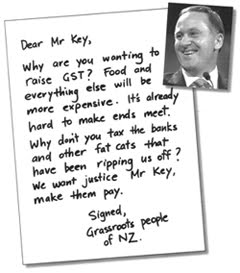
The Bad Banks campaign has drafted a letter to the prime minister on behalf of the grassroots people of New Zealand. It reads:
Dear Mr Key,
Why are you wanting to raise GST? Food and everything else will be more expensive. It's already hard to make ends meet. Why don't you tax the banks and other fat cats that have been ripping us off? We want justice Mr Key, make them pay.
Signed,
Grassroots people of NZ
With the letter the Bad Banks campaign is raising three "common sense" measures to curb banking power and protect grassroots people, which includes introducing a Robin Hood Tax. They are:
1. Stop forced mortgagee sales
Regulatory muscle used to stop banks turfing people out of their homes. A government body to oversee the re-negotiation of mortgages based on current market values and ability of the homeowner to pay.
2. Turn Kiwibank into a proper public bank
Offering 3% interest loans to first home buyers, zero-fee banking for people on modest incomes, and low interest loans to local bodies for sustainable eco-projects in the public good.
3. Introduce a Robin Hood Tax (also known as a Financial Transaction Tax)
A small percentage tax on financial transactions would net billions of dollars from banks and global financial speculators. GST could be phased out.
"We’re inviting people to sign-on electronically to our letter to prime minister John Key via the Bad Banks website www.badbanks.co.nz (or go directly to http://www.ipetitions.com/petition/badbanks/). We think a clear message needs to be sent to the government and John Key that it's the banks and other financial fats cats who must be made to pay," says Gunson.
The cartoon by KLARC accompanying this media release is available to be reproduced in print and web publications. For a bigger resolution image contact Vaughan at the email below.
For more comment, contact
Vaughan Gunson
Bad Banks spokesperson
svpl(at)xtra.co.nz
(09)433 8897
021-0415 082
Showing posts with label finance capitalism. Show all posts
13.4.10
The Crisis of Credit Visualised
The two animation videos below offer a very understandable explanation of the financial crisis sparked by the house price bust in the US. The representation of high risk mortgage borrowers is dodgy (you'll see what I mean), but on the whole their good. They show why the current strategy pursued by the global elites, basically pumping trillions of public money into the debt economy is doomed to fail. The big banks and other financial institutions want the party to continue of course - there's mega-profits to be made! So they aren't going to stop willingly. Hence the need for campaigns that target the banks and raises economic alternatives to a hyper-financialised economy that's one very big ticking bomb. To start building some public pressure against the banks sign the Make the Banks Pay online petition today, go to http://www.ipetitions.com/petition/badbanks/. Tell your friends.
The Crisis of Credit Visualised (Part 1)
The Crisis of Credit Visualised (Part 2)
4.9.09
Mega-rich bankers are squeezing the world
Text from the back page of Bad Banks leaflet #1.
The cartoon (above) shows a “fat cat” sitting on people. It’s a comical image. Unfortunately it shows a sad truth. Around the world today this is what’s happening to grassroots people like us.
The fallout from the global economic crisis is leading to millions losing their jobs. In the US, the world’s biggest economy, 1 in 6 workers are out of work. 50% of homeowners risk losing their homes.
As economies slump governments are cutting spending on health, education and other services, making things worse for grassroots people.
But while this is going on, trillions of dollars have been raised to bailout banks and other financial institutions, the very ones behind the meltdown.
Big banks, like the US based Goldman Sachs, exert enormous influence over markets. They helped inflate the global “housing bubble”.
Grassroots people all over the world got caught up in the house price spike, forced to take out big loans to buy a home. The banks, media and politicians told us it was OK. House prices, they said, would continue to rise and we’d all be better off.
This was a lie, one the banks, media and politicians were happy to peddle because all this borrowing was making a few people super-rich.
But it couldn’t last, the wages of ordinary people weren’t going up in line with house prices. It all came unstuck in 2007 when house prices in the US and elsewhere fell and indebted homeowners began defaulting on their mortgages. This caught out most of the world’s banks who all had a finger in the “housing bubble” pie.
With trillions of dollars of “bad debt” on their books the banks stopped lending. Because so much of today’s economy is founded on borrowing (by governments, business and ordinary people) to have credit freeze up was a nightmare scenario for the Kings of Capital.
To keep the profits flowing governments wrote blank cheques for the banks. A recent report calculated that the bailout figure for the US alone is expected to climb to $23.7 trillion!
The global economy, however, is still nose-diving, leading to a pandemic of job losses.
Yet out of this social misery many of the big banks are returning to profitability. Goldman Sachs is posting record profits. These mega-rich bankers are set on dominating like never before the creation of credit. They’re lending to cash-strapped governments at high interest rates. They’re speculating again in financial markets. It’s “win-win” for them and “lose-lose” for us.
A system that can divert trillions of dollars to a mega-rich minority and let the majority fend for themselves is an unjust one. The fat cats are sitting on top of us. And that has to be changed. The Bad Banks campaign is where it starts.
The cartoon (above) shows a “fat cat” sitting on people. It’s a comical image. Unfortunately it shows a sad truth. Around the world today this is what’s happening to grassroots people like us.
The fallout from the global economic crisis is leading to millions losing their jobs. In the US, the world’s biggest economy, 1 in 6 workers are out of work. 50% of homeowners risk losing their homes.
As economies slump governments are cutting spending on health, education and other services, making things worse for grassroots people.
But while this is going on, trillions of dollars have been raised to bailout banks and other financial institutions, the very ones behind the meltdown.
Big banks, like the US based Goldman Sachs, exert enormous influence over markets. They helped inflate the global “housing bubble”.
Grassroots people all over the world got caught up in the house price spike, forced to take out big loans to buy a home. The banks, media and politicians told us it was OK. House prices, they said, would continue to rise and we’d all be better off.
This was a lie, one the banks, media and politicians were happy to peddle because all this borrowing was making a few people super-rich.
But it couldn’t last, the wages of ordinary people weren’t going up in line with house prices. It all came unstuck in 2007 when house prices in the US and elsewhere fell and indebted homeowners began defaulting on their mortgages. This caught out most of the world’s banks who all had a finger in the “housing bubble” pie.
With trillions of dollars of “bad debt” on their books the banks stopped lending. Because so much of today’s economy is founded on borrowing (by governments, business and ordinary people) to have credit freeze up was a nightmare scenario for the Kings of Capital.
To keep the profits flowing governments wrote blank cheques for the banks. A recent report calculated that the bailout figure for the US alone is expected to climb to $23.7 trillion!
The global economy, however, is still nose-diving, leading to a pandemic of job losses.
Yet out of this social misery many of the big banks are returning to profitability. Goldman Sachs is posting record profits. These mega-rich bankers are set on dominating like never before the creation of credit. They’re lending to cash-strapped governments at high interest rates. They’re speculating again in financial markets. It’s “win-win” for them and “lose-lose” for us.
A system that can divert trillions of dollars to a mega-rich minority and let the majority fend for themselves is an unjust one. The fat cats are sitting on top of us. And that has to be changed. The Bad Banks campaign is where it starts.
25.8.09
Why we need to battle the banks
by Vaughan Gunson
The recession is taking grip in New Zealand. People are losing their jobs. In some grassroots communities unemployment is already turning into a social crisis.
138,000 people are officially unemployed. Thousands more will be desperately looking for work. And the situation is going to get grimmer as the economy slumps further.
Job losses and income cuts are putting many homeowners in a terrible situation. They can’t meet their mortgage payments. The banks are knocking at the door.
And with property values falling some people are left owing more money to the banks than their home is worth. They face financial ruin.
For grassroots people, this is all very frightening and unfair.
Grassroots mood against the banks
Jobs and homes are gut issues for people. Rising concern about these gut issues is intersecting with a mass mood against the banks.
Last year, RAM activists took a survey out on to the streets, which questioned people about the operations of the banks in this country. Over 90% of people thought the banks were doing no good.
That sentiment has probably hardened. It can be picked up in everyday conversations. It’s reflected in the stories being carried in the media.
You know there’s a mass mood on an issue in New Zealand when two things happen. The first is when it becomes a storyline on Shortland Street. Scotty and Shanti are in trouble with the bank, owing more than their house is worth.
The second indicator of a mass mood is when you start hearing calls for a public enquiry.
This is what the Green, Labour and Progressive parties have been voicing. They want an independent public enquiry into the banks. They’ve sensed the mood and the political opportunities that it presents.
Not right
In the eyes of grassroots people it’s not right that in these times of increasing hardship the banks are continuing their profit run.
The Big Four Australian-owned banks, ANZ National Bank, BNZ, Westpac and ASB, control 90% of the banking industry in New Zealand, putting them in a near-monopoly position.
With so much market control, there’s no pressure to lower interest rates. In 2008, the income the Big Four banks received from loan interest went up a whopping $4.6 million.
As a result the profits of these Aussie-owned banks totalled over $3 billion in 2008, up 3.7% on the year before.
To add fuel to the fire, the Big Four are trying to avoid paying a tax bill of $2.25 billion. BNZ has been convicted by the High Court and told to pay up. Undaunted, the banks are using their extreme wealth to hire teams of lawyers to fight the ruling.
The feelings people have towards the banks has been heading South for sometime. This was before the banks started turfing people out of their homes.
To maintain their own equity position the banks are getting tough and forcing mortgage sales in rapidly increasing numbers. In April this year, there were 250 foreclosures. The numbers are only going to escalate as mortgage pressures worsen with further waves of job losses.
The banks are the bad guys. They could become public enemy number one.
A Bad Banks campaign
In isolation grassroots people have no power against the banks and the laws written to protect the money men. But mass feelings are strong.
It is the job of mass Marxists to tap into those mass feelings. That’s why Socialist Worker is launching a “Bad Banks” campaign.
We believe the Aussie banks are vulnerable to a broad and inclusive campaign that connects with the anger ordinary people feel towards these mega-rich interest gauges.
A campaign to expose and shame the banks must be out on the streets. We’ll produce mass leaflets and posters. There will be street stalls. We can build towards publicity pickets outside targeted banks.
We will organise public meetings. Send out media releases, write submissions. We will liaise with others on the left about organising jointly hosted campaign conventions.
The campaign will have a web presence (www.badbanks.co.nz). A Bad Banks Facebook group is up and running (log into Facebook and search for “Bad Banks”).
We will pursue multiple publicity strands that aim to connect with masses of grassroots people.
The first stage of the campaign will be educative. We’ll tell people what the banks are up to. We’ll even explain in popular language “fractional reserve lending”, the credit creation mechanism which literally allows the banks to make money out of thin air.
Our leaflets and other publicity will connect the operations of the banks to the Great Implosion. Explaining what’s happening globally and pointing the finger at who’s responsible. Knowledge, as they say, is the first step to empowerment.
As the Bad Banks campaign evolves we begin to put forward concrete demands and campaign goals. These will emerge through dialogue with other leftists and through listening to grassroots people themselves.
Broad left cooperation
A multi-headed campaign against the banks has the potential to bring networks of indebted homeowners, political parties, unions, community groups and grassroots activists together.
The campaign on the streets should work in tandem with the good initiative of the Green, Labour and Progressive parties to set up their own independent public enquiry into the banks. Parliamentary and street campaigning can both work to build a movement. Linking these two essential political arenas will get the best out of each.
The Bad Banks campaign (or some other campaign name that emerges through discussions with others) could become an invigorating example of broad left political cooperation in practice. This would be extremely positive.
Joint work, sharing of ideas and on-the-ground collective organisation around this “flashpoint” political issue will hopefully encourage a further coming together of broad left forces. Such political cooperation is needed if the left is to rise to the challenge of the biggest economic meltdown since the Great Depression of the 1930s.
Banks and the “bubble economy”
The role the banks and international money men have played in the Great Implosion needs to be widely exposed. The banks are at the centre of the “bubble economy” built on trillions of dollars of debt and speculation.
The floundering of the real economy since the 1970s has seen workers, business and the state increasingly reliant on the extension of credit.
Over the last four decades debt has ballooned. This has allowed the banks and other money lenders, facilitated by governments, to assume a dynamic role within late capitalism.
So entwined are industry giants, big banks and governments, that when the credit crunch hit last year, following the bursting of the worldwide housing bubble, the leaders of the world’s big economies raced to save the banks.
In January this year, Oxfam calculated that $8.424 trillion had so far been raised by governments to bailout the banks and other financial institutions. That’s a vast sum, one which could easily put an end to world poverty.
And the bailouts haven’t stopped. In the US alone, the Obama administration’s bailout commitments could reach as high as $23.7 trillion, according to an official independent report.
However, the bailouts have not prevented the economy from nose-diving, far from it. There’s a global pandemic of job losses and other social miseries. Smaller banks and other financial institutions continue to go under.
Yet some of the big banks, like Goldman Sachs, one of the main players behind the housing bubble, are now posting record profits. With trillions and trillions of government money floating around, these experts at financial manipulation are creaming it.
Helped by government insiders the really big banks are now set on dominating like never before the creation of credit, the fragile base upon which the world economy rests.
The banks left standing are profiting out of lending to cash-strapped governments at high interest rates. They’re speculating again in financial markets. It’s “win-win” for them and “lose-lose” for the rest of us.
Given all the social and environmental problems besetting the world the bailout of bankers is a crime against humanity of obscene proportions.
Debating the nature of capitalism
A system that can divert trillions of dollars to a mega-rich minority and let the majority fend for themselves in an increasingly scary world is an unjust one.
Without a doubt the global economic crisis, and the response by governments, is eroding the legitimacy of the market. And it’s happening in the so called “first world” economies of Northern America and Europe. That’s significant.
A broad campaign against the banks in this country will, if successful, begin to expose the structures of power within monopoly finance capitalism that locks in place gross inequalities globally.
A mass-based campaign against Bad Banks has the potential to stimulate a nationwide debate about the nature of capitalism and the need for a human centred economy. Socialists and leftists from a number of political traditions will want to see this happen.
Lots to learn, lots to get excited about
The Bad Banks campaign that Socialist Worker is initiating will be a long term one. We will be trying things out as we search, hopefully alongside other activists, for a connection with a mass audience.
There’s lots to learn about the operations of the banks in this country and internationally, and how to connect their operations to a system in crisis. It’s going to be a big learning curve for everyone involved.
While the Bad Banks campaign is only just hitting the streets, it’s yet to be fully tested in practice, we do know there’s great resentment towards the banks amongst ordinary Kiwis. We should have confidence that this path will bear fruit for the left in this country. That prospect should be an exciting one.
Vaughan Gunson is the publicity coordinator for the Bad Banks campaign. To contact him with feedback or offers to help, email socialist-worker@pl.net or ph/txt 021-0415 082.
The recession is taking grip in New Zealand. People are losing their jobs. In some grassroots communities unemployment is already turning into a social crisis.
138,000 people are officially unemployed. Thousands more will be desperately looking for work. And the situation is going to get grimmer as the economy slumps further.
Job losses and income cuts are putting many homeowners in a terrible situation. They can’t meet their mortgage payments. The banks are knocking at the door.
And with property values falling some people are left owing more money to the banks than their home is worth. They face financial ruin.
For grassroots people, this is all very frightening and unfair.
Grassroots mood against the banks
Jobs and homes are gut issues for people. Rising concern about these gut issues is intersecting with a mass mood against the banks.
Last year, RAM activists took a survey out on to the streets, which questioned people about the operations of the banks in this country. Over 90% of people thought the banks were doing no good.
That sentiment has probably hardened. It can be picked up in everyday conversations. It’s reflected in the stories being carried in the media.
You know there’s a mass mood on an issue in New Zealand when two things happen. The first is when it becomes a storyline on Shortland Street. Scotty and Shanti are in trouble with the bank, owing more than their house is worth.
The second indicator of a mass mood is when you start hearing calls for a public enquiry.
This is what the Green, Labour and Progressive parties have been voicing. They want an independent public enquiry into the banks. They’ve sensed the mood and the political opportunities that it presents.
Not right
In the eyes of grassroots people it’s not right that in these times of increasing hardship the banks are continuing their profit run.
The Big Four Australian-owned banks, ANZ National Bank, BNZ, Westpac and ASB, control 90% of the banking industry in New Zealand, putting them in a near-monopoly position.
With so much market control, there’s no pressure to lower interest rates. In 2008, the income the Big Four banks received from loan interest went up a whopping $4.6 million.
As a result the profits of these Aussie-owned banks totalled over $3 billion in 2008, up 3.7% on the year before.
To add fuel to the fire, the Big Four are trying to avoid paying a tax bill of $2.25 billion. BNZ has been convicted by the High Court and told to pay up. Undaunted, the banks are using their extreme wealth to hire teams of lawyers to fight the ruling.
The feelings people have towards the banks has been heading South for sometime. This was before the banks started turfing people out of their homes.
To maintain their own equity position the banks are getting tough and forcing mortgage sales in rapidly increasing numbers. In April this year, there were 250 foreclosures. The numbers are only going to escalate as mortgage pressures worsen with further waves of job losses.
The banks are the bad guys. They could become public enemy number one.
A Bad Banks campaign
In isolation grassroots people have no power against the banks and the laws written to protect the money men. But mass feelings are strong.
It is the job of mass Marxists to tap into those mass feelings. That’s why Socialist Worker is launching a “Bad Banks” campaign.
We believe the Aussie banks are vulnerable to a broad and inclusive campaign that connects with the anger ordinary people feel towards these mega-rich interest gauges.
A campaign to expose and shame the banks must be out on the streets. We’ll produce mass leaflets and posters. There will be street stalls. We can build towards publicity pickets outside targeted banks.
We will organise public meetings. Send out media releases, write submissions. We will liaise with others on the left about organising jointly hosted campaign conventions.
The campaign will have a web presence (www.badbanks.co.nz). A Bad Banks Facebook group is up and running (log into Facebook and search for “Bad Banks”).
We will pursue multiple publicity strands that aim to connect with masses of grassroots people.
The first stage of the campaign will be educative. We’ll tell people what the banks are up to. We’ll even explain in popular language “fractional reserve lending”, the credit creation mechanism which literally allows the banks to make money out of thin air.
Our leaflets and other publicity will connect the operations of the banks to the Great Implosion. Explaining what’s happening globally and pointing the finger at who’s responsible. Knowledge, as they say, is the first step to empowerment.
As the Bad Banks campaign evolves we begin to put forward concrete demands and campaign goals. These will emerge through dialogue with other leftists and through listening to grassroots people themselves.
Broad left cooperation
A multi-headed campaign against the banks has the potential to bring networks of indebted homeowners, political parties, unions, community groups and grassroots activists together.
The campaign on the streets should work in tandem with the good initiative of the Green, Labour and Progressive parties to set up their own independent public enquiry into the banks. Parliamentary and street campaigning can both work to build a movement. Linking these two essential political arenas will get the best out of each.
The Bad Banks campaign (or some other campaign name that emerges through discussions with others) could become an invigorating example of broad left political cooperation in practice. This would be extremely positive.
Joint work, sharing of ideas and on-the-ground collective organisation around this “flashpoint” political issue will hopefully encourage a further coming together of broad left forces. Such political cooperation is needed if the left is to rise to the challenge of the biggest economic meltdown since the Great Depression of the 1930s.
Banks and the “bubble economy”
The role the banks and international money men have played in the Great Implosion needs to be widely exposed. The banks are at the centre of the “bubble economy” built on trillions of dollars of debt and speculation.
The floundering of the real economy since the 1970s has seen workers, business and the state increasingly reliant on the extension of credit.
Over the last four decades debt has ballooned. This has allowed the banks and other money lenders, facilitated by governments, to assume a dynamic role within late capitalism.
So entwined are industry giants, big banks and governments, that when the credit crunch hit last year, following the bursting of the worldwide housing bubble, the leaders of the world’s big economies raced to save the banks.
In January this year, Oxfam calculated that $8.424 trillion had so far been raised by governments to bailout the banks and other financial institutions. That’s a vast sum, one which could easily put an end to world poverty.
And the bailouts haven’t stopped. In the US alone, the Obama administration’s bailout commitments could reach as high as $23.7 trillion, according to an official independent report.
However, the bailouts have not prevented the economy from nose-diving, far from it. There’s a global pandemic of job losses and other social miseries. Smaller banks and other financial institutions continue to go under.
Yet some of the big banks, like Goldman Sachs, one of the main players behind the housing bubble, are now posting record profits. With trillions and trillions of government money floating around, these experts at financial manipulation are creaming it.
Helped by government insiders the really big banks are now set on dominating like never before the creation of credit, the fragile base upon which the world economy rests.
The banks left standing are profiting out of lending to cash-strapped governments at high interest rates. They’re speculating again in financial markets. It’s “win-win” for them and “lose-lose” for the rest of us.
Given all the social and environmental problems besetting the world the bailout of bankers is a crime against humanity of obscene proportions.
Debating the nature of capitalism
A system that can divert trillions of dollars to a mega-rich minority and let the majority fend for themselves in an increasingly scary world is an unjust one.
Without a doubt the global economic crisis, and the response by governments, is eroding the legitimacy of the market. And it’s happening in the so called “first world” economies of Northern America and Europe. That’s significant.
A broad campaign against the banks in this country will, if successful, begin to expose the structures of power within monopoly finance capitalism that locks in place gross inequalities globally.
A mass-based campaign against Bad Banks has the potential to stimulate a nationwide debate about the nature of capitalism and the need for a human centred economy. Socialists and leftists from a number of political traditions will want to see this happen.
Lots to learn, lots to get excited about
The Bad Banks campaign that Socialist Worker is initiating will be a long term one. We will be trying things out as we search, hopefully alongside other activists, for a connection with a mass audience.
There’s lots to learn about the operations of the banks in this country and internationally, and how to connect their operations to a system in crisis. It’s going to be a big learning curve for everyone involved.
While the Bad Banks campaign is only just hitting the streets, it’s yet to be fully tested in practice, we do know there’s great resentment towards the banks amongst ordinary Kiwis. We should have confidence that this path will bear fruit for the left in this country. That prospect should be an exciting one.
Vaughan Gunson is the publicity coordinator for the Bad Banks campaign. To contact him with feedback or offers to help, email socialist-worker@pl.net or ph/txt 021-0415 082.
Subscribe to:
Posts (Atom)