13.3.10

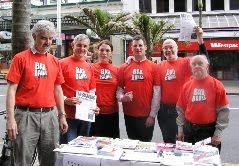
Bad Bank wins Roger Award


ANZ has won the Roger Award for the worst transnational corporation operating in New Zealand in 2009. Below is the judge's statement relating to the winner, ANZ. The judges were Christine Dann, Bryan Gould, Joce Jesson, Paul Corliss and Wayne Hope.

The Roger Award is organised each year by CAFCA (Campaign against Foreign Control of Aotearoa).

From the judge's statement:

The Winner: ANZ

The judges all noted the generally egregious behaviour of the Australian-owned banks that were nominated (ANZ, BNZ and Westpac), and were unanimous in picking them as the worst TNCs operating in New Zealand in 2009.

As the Council of Trade Unions noted in its submission to the Independent Parliamentary Banking Inquiry, the foreign–owned banks are the Achilles heel of the New Zealand economy, given that they contribute to the lion’s share of the national debt. They account for nearly 70% of investment income debts on the national balance of payments and for 74% of the economy’s net overseas indebtedness.

During the 2009 year the banks were accused of:

1. Distorted lending margins in their favour and against their customers
2. Tax dodging on a grand scale
3. Poor lending and investment practices
4. Overcharging and profiteering
5. Poor employment and customer service practices

The banks behaved so badly in 2009 (and 2008) that they were the subject of a Parliamentary Select Committee investigation early in 2009. Despite receiving reports giving good reason to conclude that strong Government action was needed to rein in the bad behaviour of the banks, and to require them to deal with both customers (and the Government, which provided them with security during the 2008 financial crisis) more honestly and fairly, the National Party-dominated Select Committee did not recommend such actions to Government. This led to the Labour, Green and Progressive MPs setting up their own Independent Parliamentary Banking Inquiry. This Inquiry exposed more issues of concern, and called for better legislation and regulation to protect the public from predatory banks.

Also during 2009, bank after bank appeared before the High Court to answer allegations of tax evasion, amounting to billions of dollars. After high level negotiations they finally reached an out-of-court settlement that saw them collectively pay the Inland Revenue Department more than $2.2 billion. In a political climate where we are constantly being told that taxes are an evil imposition, rather than what they really are - the price we pay for a democratic and functional society - we think that a special Public Heroes award should go to the Government lawyers, IRD officials and others responsible for getting these slippery banking snakes to pay what they rightly owe the nation.

One of the Roger Award judges noted the banks were richly deserving of the Award since they have been ''...doing great damage for many years to the whole of the New Zealand economy …through irresponsible lending (thereby stoking inflation), and expatriating excessive profits … while all the time avoiding censure and pointing the finger at public spending as the cause of our economic problems…[While] this year we have seen the truly scandalous tax avoidance saga, from which the banks have again escaped remarkably lightly; if you or I had committed a similar offence of one thousandth the size we would have ended up in jail.”

However, it was a tough decision to pick the worst of the worst, considering that all the foreign-owned banks were guilty of some degree of tax dodging, overcharging on credit card fees and loans, not passing on reductions in interest rates, and treating customers and staff poorly. In the end the judges decided that ANZ deserved top place, with the ING scandal tipping the balance in its favour (for full details of the ING scandal, see the next section “Rattlesnakes In the Grass’).

In 2008 ANZ was also a finalist, with the 2008 judges noting the following ‘fine’ qualities for its inclusion:
“Evidence presented to the judges portrayed ANZ-National as the most rapacious, inept and irresponsible of the banks over the past couple of years, which assured it a good chance of securing the Roger Award. This bank was a distinguished finalist in 2007 also, for its despicable role in the saga of Godfrey Hirst and the Feltex carpet business”.
ANZ has succeeded in winning the 2009 Roger Award because the ING funds fiasco is simply and plainly ‘pure greed capitalism’ at its worst. This debacle saw the bank immorally misleading small investors into taking their money out of safe term deposits and putting it into highly risky investments, while assuring them that these investments were safe. In fact, most of them were highly dangerous and dodgy, and lost millions of investors' money. When the betrayed investors got organised and put pressure on the bank to repay what had been lost, ANZ's repayment offer came with big strings attached - investors who refused to sign a waiver agreeing not to take legal action against the bank would receive no compensation. In the words of the judges, this was ‘the most extreme case of anti-democratic manipulation by a transnational within New Zealand during 2009. Simply, ANZ was employing financial pressure to erase the legal rights of investors – a truly Roger winning performance.’

The ING debacle was, as one judge noted, ‘the icing on the already baked Roger cake.’ Thus ANZ is the winner of the 2009 Roger Award.

2.3.10

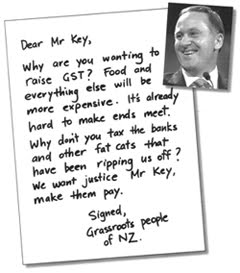
We could replace tax on essentials with one on destructive speculation

by Barry Coates
from stuff.co.nz
2 March 2010

Some things seem too good to be true. But sometimes it's because they are good ideas whose time has come. One of those is the proposal to levy a tiny tax on the massive movements of money around the world. It's time our Government looked more closely at it.

Why? Because a financial transactions tax will raise significant revenue without adversely affecting most New Zealanders, support our international obligations and reduce the volatility of our currency. It's a win-win-win.

Instead, our Government's attention has been focused on incremental tax reforms that shuffle taxes from one pocket to the other - lower direct taxes and higher GST. The net effect inevitably seems to be that those on lower incomes bear a greater share of the burden. This is all "business as usual" ignoring some longer-term challenges that we face - reform of the financial sector to curb excessive risk-taking, making the transition to a low-carbon economy, and playing our part in the global effort to eradicate extreme poverty.

The proposed FTT is a levy of 0.05 per cent, on average, applied to the trading of a range of equities, bonds, derivatives and foreign exchange transactions (ie 5 cents for a transaction of $100). Such a tax is predicted to curb a lot of speculative activity, but would still raise NZ$570 billion a year globally.

It sounds like a radical proposal, but it is really like extending GST, at a much reduced rate, to wholesale financial transactions - they are currently exempt. It is supported by Japan and leaders of the three largest EU countries - Gordon Brown, Angela Merkel and Nicolas Sarkozy - along with hundreds of eminent economists, financial regulators like Lord Turner and Paul Volcker, financial traders like George Soros and investment guru Warren Buffet.

An international agreement for all countries to introduce a common FTT at the same time would be ideal. This approach is now being considered by the IMF and G20 countries. It should be supported by our Government. But difficulties in getting such a deal should not prevent countries from moving ahead themselves.

Belgium already runs a limited form of FTT and its banking sector has not suffered. A co-ordinated approach would be preferable, but any government can now introduce a levy on trading of their currency, no matter where the transactions take place. The high level of automation in the banking industry makes administration feasible at a low cost.

Ad Feedback
This tax would miss the average bank customer completely, even those buying foreign currency to travel overseas. It is a tax on wholesale finance - it would apply to the high-volume, high-frequency trading and speculation that sees massive sums of money being transferred at a keystroke. The "casino economy" of global finance has grown rapidly in recent years - international financial transactions are now 60 times the level of world GDP. Unfortunately the real economy is not insulated from its collapses. The financial crisis cost the world a staggering US$11.9 trillion, according to the IMF.

The finance industry is a deliberate target for the FTT. It is the most profitable industry in the world, with profits per employee 26 times as high as other business sectors. And, as we have seen in New Zealand, banks are adept at using legal loopholes and tax havens to avoid paying their fair share of tax. The FTT could generate enough revenue to avoid raising GST, replacing taxes on life's essentials with a tax on socially destructive financial speculation. This is consistent with the principle of taxing activities that we want to discourage, as opposed to taxing productive work or basic necessities.

Nobel-prize-winning economist James Tobin described such a tax as "throwing sand in the wheels" of international currency trading. Some sand may well help reduce the volatility of the New Zealand dollar, which attracts massive trading and speculative attacks - according to the Bank of International Settlements, the Kiwi dollar is the 11th most traded currency, far beyond our role in the real economy.

The proposal put forward by a large coalition of groups internationally, under the banner of the "Robin Hood" tax, is that half of the funds raised would be used domestically to help fund public services and reduce government deficits resulting from the financial crisis. A quarter of the funds would be contributed to support international efforts to overcome extreme poverty in the developing world and support the countries that have suffered most from the financial crisis.

The balance would be used to tackle climate change. It could dramatically reduce the emissions from global deforestation and provide most of the funding that is needed by vulnerable countries, including our Pacific neighbours, to protect themselves and adapt to climate change impacts.

Before we dismiss the idea, consider this: just two minutes of a global FTT could pay for basic healthcare for 100,000 people. Two months of the FTT would provide the funds necessary to get every child on Earth into school.

Our Government should take a close look.

Barry Coates is the executive director of Oxfam New Zealand.

20.2.10

Robin Hood tax has Bono and co all a-quiver

by Finlay MacDonald
from Sunday Star Times
14 February 2010

One should always be wary of seemingly simple solutions to seemingly intractable problems – especially solutions endorsed by Bono. Yet the idea of a "Robin Hood tax" on global financial transactions, despite appearing almost too good to be true and, yes, backed by U2's blathering messiah of world peace himself, really is hard to fault.

From a New Zealand perspective the launch of a fresh campaign for such a tax was beautifully timed, coinciding as it did with the timid revenue tinkering proposed by the prime minister. If you'd found yourself drifting off listening to John Key's uninspiring prescriptions, you could have hopped on YouTube and watched the snakily funny Bill Nighy video in which he plays a smarmy banker failing to justify his opposition to a Robin Hood tax.

Like most bankers and tax experts who thrive on the perceived complexity of their fields, simplicity and common sense is his enemy. The central genius of the Robin Hood idea is that it treats the global financial system for what it really is – an economic activity that can be taxed like anything else. Indeed, since so much of the world's total corporate profits now derive from unproductive speculative trades and other money-go-rounds – a phenomenon sometimes described as the "financialisation" of the economy – it's long overdue for scrutiny.

The idea is not particularly new, but it gained new impetus with the global financial crisis and the debate about longer-term remedies for reckless investment banking and foreign exchange dealing. The primary purpose of such a tax, in fact, would be to take some of the heat out of money markets and reduce exchange rate volatility. As its original proponent James Tobin put it, it would "put sand in the wheels of international finance" by creating a major disincentive to short-term speculative transactions.

One benefit of this – aside from curbing the sort of market panics that trigger major crises and ruin ordinary people's lives – would be the diversion of investment back towards the productive sectors. Also, and not least, it would raise the kind of money that makes a difference to the worthy goals humanity (and Bono) aspires to, like fighting poverty and climate change.

Of course, if successful, such a tax would reduce its own potential revenue base, which is why estimates of what it might generate are problematic. However, given that roughly $1.5 trillion is traded in world currency markets each day, even a significantly reduced amount would yield a hefty annual tax take. And it's not as if anyone is arguing for a regime so punitive it would put forex dealers out of work and shut Lamborghini showrooms. Suggestions of between 0.05 and 0.25 percent could raise between $90 and $300 billion a year, depending on the forecast. According to a report by liberal think tank The New Economics Foundation, quoting previous expert analysis including research by the IMF, a currency transactions tax is administratively and logistically feasible – albeit dependent on international political co-operation.

Well, there had to be a catch. Getting governments to agree on such a policy when they are so much in thrall to their domestic financial lobbies would be about as easy as achieving that other noble goal, world peace. British Prime Minister Gordon Brown advocated such a tax at the G20 meeting late last year and continues to promote the idea. Yet only last month the governor of the Bank of England humiliated him by dismissing the proposal as "bottom of the list" of reform options.

In the US, source of the present crisis (which is far from over), Wall Street has very effectively blocked all attempts at reform, historically and now. It's brazen and shameless – how else to explain a banking sector that could revive its morally obscene bonus culture within months of being bailed out with billions upon billions of public dollars? Expecting such creatures to act other than purely self-interestedly is futile.

Outside the banker bubble, though, there is plenty of support for a Robin Hood tax, including from industry leaders, who actually make and sell stuff.

As the boss of New Zealand fishing giant Sanford said to shareholders just the other day, "A tax on non-trade-related currency transactions could not only earn significant income for the government, it could also result in our exchange rate moving closer to its realistic value and thereby add significant value to the wealth of New Zealanders." Now there's a tax reform plan with genuine vision – precisely why this government and its former merchant banker boss could never come up with it.

finlay.macdonald@star-times.co.nz

The Robin Hood Tax - Video

Bank wholesale guarantee could be ending – time for a new bank tax?

from the gossip...
Finsec Union's unofficial weblog
11 Feb 2010

The New Zealand government is sending signals that its wholesale funding guarantee for banks could be winding down, following a decision to end the similar scheme in Australia.

Finsec Campaigns Director Tali Williams said that any end to the wholesale funding guarantee should be accompanied by a tax like that being discussed in Europe and America in order to ensure that banks are paying their fair share of taxes – given the huge influence and risks they pose to our global and national economies.

“A tax like Obama and other world leaders are proposing would give greater security to our economies.  It would also provide much needed income to address both the impacts of the global financial crisis and pressing needs of many countries to do more to assist their citizens and taxpayers – not less.”

A campaign for a global tax on banks’ financial transactions, dubbed a “Robin Hood” tax, was launched last week by 50 organisations including Oxfam, aid agencies, unions, environmental groups and economists. Actor Bill Nighy fronts a promotional film for the tax – you can check it out at the link below:

http://robinhoodtax.org.uk/

9.2.10

Westpac chief treats herself

from ...the gossip
Finsec Union's unofficial weblog
8 February 2010   

Westpac CEO Gail Kelly recently spent $11.2 million on a new property in an affluent Sydney beach suburb. The two-hectare property features an indoor heated pool, a spa, a tennis court and incredibly, an Olympic equestrian arena! So extravagant was the price tag, it marked a record price for any property in the district.

Gail Kelly’s splurge looks even more out of place when many of the bank’s customers and staff (in New Zealand and Australia) are feeling the pinch of the recession. Nice for some!

31.1.10

Bad banks — New Zealand’s black sheep

by Paola Harvey
from Green Left Weekly (Australia)
30 January 2010

Although New Zealand, like Australia, has not been as badly affected by the global economic crisis as the US or Europe, workers are facing hardship.

Bronwen Beechey, an activist from Socialist Worker New Zealand (SWNZ), told Green Left Weekly: “There’ have been a lot of redundancies, places have been closed down.”

Beechey and SWNZ activist Peter Hughes were in Sydney to attend the January 3-6 Socialist Alliance national conference. They spoke to GLW about the SWNZ’s “bad banks” campaign, which takes aim at the cause of the global financial crisis — neoliberal capitalism.

“For people on low incomes life’s just been getting tougher because [they are] losing their jobs and food prices and rents and all of it have not come down substantially”, Beechey said.

“All the indicators, the social services, people asking for assistance, for food parcels, people losing their homes — they’ve all skyrocketed.”

Hughes said employers have used the crisis to justify attacking workers’ wages and conditions. “In the last 12 months, there have been no less than eight lockouts of workers.

“One of the most shameful examples was a service provider for the elderly that insisted that if the workers in that field did not accept the minimum wage [NZ$12.50 per hour] they’d be locked out.

“That’s quite a serious indication of how they [the bosses] see the crisis being resolved to their advantage and workers’ disadvantage.”

The New Zealand government’s response has been the same as capitalist governments around the world — bail out the banks and the big capitalists, and make the workers pay.

But they are not getting it all their own way. The government’s attempt to impose an unofficial wage freeze in the public service was recently challenged. Support staff in the education sector won a small wage rise.

That win will set the tone for the upcoming nurses’ and general education unions’ wage negotiations. “No less than that, will be the call, I’m sure”, said Hughes. “So that’s a good sign.

“I heard at the [Socialist Alliance] conference, that [Australian Prime Minister Kevin Rudd] said that the recovery’s going to be worse than the recession.

“I’m quite sure that’s their intention for us in New Zealand as well, working people will be made to pay for the recovery — if there’s going to be one.

“But our assessment is that there can be no real recovery in the current market economy, not in the foreseeable future. That’s going to lead to all sorts of crises for them, which they will try to push on us.

“We have to organise people to resist that.”

The discussion about neoliberalism at the NZ Council of Trade Unions’ 2009 conference has opened up more space on the left to fight back against these future crises.

At the conference, union activists talked about workers’ cooperatives, building and strengthening the union movement and not accepting the neoliberal capitalist model as the only option.

Beechey said: “It also talk[ed] about climate change and the need for an alternative economic strategy which is an implicit criticism of neoliberal capitalism.”

Hughes added: “While it’s not a policy position as such, it’s a discussion that’s been opened up within the trade union movement.

“It’s not an accepted policy, it could be watered down significantly and it’ll come down to how different unions interpret that for building a broader perspective in the membership.

“[But] when you think about how closely linked the trade union movement has been to the Labour Party … this is a departure.

“The fact that they’re daring to criticise publicly this position opens up a space on the left for us to work with trade union activists in a much more healthy and progressive way.”

Many people in New Zealand continue to struggle with little indication of their situation improving in the near future.

There has been an increase in the number of houses sold due to people defaulting on their home loans. A large proportion of these have been people with one home — not property speculators.

Hughes said the defaulters “simply cannot pay because they’ve lost their job, they’ve been made redundant and they have reduced incomes”.

“That’s pretty devastating for families and has shown no sign of abating at all.”

The actions of the banks have been completely shameful. Before the crisis, banks were advertising loans for 100% of the price of a house.

But after the crisis, their ruthless approach to lending has meant many people who were lured into the property market by these loans have had their home repossessed.

“Our campaign around ‘bad banks’ is trying to make them pay really”, said Hughes. “Because they’re the ones that have played a big role [in the crisis] and they’re plundering the profits of working people.”

The bad banks campaign is focusing on demystifying what the banks actually do and how they caused the financial crisis. It is also calling for a financial transaction tax, as opposed to a goods and services tax.

A GST is a regressive tax, that is it affects the poorest the most, because the poor are taxed the same as the rich for goods despite having less ability to pay.

A financial transaction tax, on the other hand, would be a progressive tax. It would affect banks, corporations and the wealthy the most, because they account for the vast majority of financial transactions.

“We see the bad banks campaign as striking right to the heart of neo-liberalism”, Hughes said. “These banks have got their fingers in the lives of every working class person, whether it’s controlling their mortgage, their credit card, or their bank charges.

“They’re bloody pillaging basically. Their pockets are huge, they’re not paying their taxes.

“They’re not very popular with workers at the moment.”