by Damien Millet and Sophie Perchellet and Eric Toussaint
from Global Research
3 April 2009
There is a striking contrast in the most industrialized countries at the epicenter of the global crisis that broke out in 2007-2008: the governments and their friends running the major banks are congratulating themselves on having saved the financial sector and initiated limited economic recovery, but people’s living conditions continue to deteriorate. Furthermore, with stimulus packages for the economy of over 1000 billion dollars, the major financial institutions have received government aid in the form of bail out funds, but the different States have no say in the management of these companies or are not taking advantage of this opportunity to radically change the policies governing them.
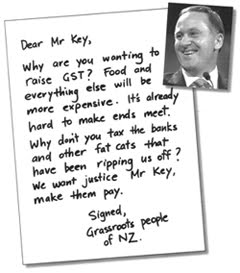
The path chosen by governments to emerge from the private financial crisis caused by bankers has led to an explosion in public debt. For many years to come, this sudden growth in public debt will be used by governments as a form of blackmail to impose social cuts and to deduct from the wages of “those at the bottom” the money needed to repay the public debt now held over our heads by the financial markets. How will this scenario be played out? Direct taxes on high income earners and companies will be reduced, while indirect taxes, such as VAT, will increase. Yet, as a percentage of disposable income, VAT is mainly a burden on low income households, which makes it an extremely unfair tax. For example, with a 20% VAT tax, a poor household that spends all its income just to survive, pays the equivalent of a 20% tax on its income, whereas a well off household, which saves 90% of its income, and therefore only spends 10% of it on daily expenses, pays the equivalent of a 2% tax on its income.
Therefore, the richest win twice: as a percentage of their disposable income, they contribute the least amount to taxes, and with the sums they have saved, they buy stocks of public debt and make profit from the interest paid by the State. On the contrary, wage earners and pensioners are doubly penalized: their taxes increase while public services and their social security benefits deteriorate. The repayment of public debt is therefore a mechanism for transferring revenue from “those at the bottom” to “those at the top”, as well as an effective form of blackmail in order to pursue neo-liberal policies benefitting “those at the top”.
Meanwhile, profits and bonus distributions (in 2009, 1.75 billion euros in bonuses for the traders of French banks, and 20.3 billion dollars for Wall Street traders -- a 17% increase compared to 2008!) have returned to their mad ways while the people are called upon to tighten their belts. In addition, with the easy money central banks lend them, bankers and other institutional investors have launched into new speculative operations, which are highly dangerous for the rest of society, as we have seen with the Greek debt for example, not to mention the price of raw materials and the dollar. Not a word from the International Monetary Fund (IMF) or the Organization for Economic Cooperation and Development (OECD), and a refusal from the G20 to take measures on bonuses and speculation. Everyone agrees to intensify the race for profit based on the pretext that this will eventually lead to job creation.
The Finance Ministers’ overall objective is a return to growth, even if it turns out to be unequal and harmful to the environment. In no way do they question the system which has proven to be a failure. If they do not react, the dismantling of the State will be pushed to its limits, and the entire cost of the crisis will be borne by the very people who are its victims, while those responsible for it will emerge more powerful than ever before. Today, banks and hedge funds have been saved with public money without offering the slightest tangible compensation in return.
We believe public policy should be reformulated as follows: “You large creditors have greatly profited from public debt, but fundamental human rights are seriously threatened and inequalities are widening at an alarming rate. Our priority is to maintain and guarantee these fundamental rights and it is you, the large creditors, who should pay for this. We are going to tax you according to the amount that you loaned back to us: the money will not come out of your pockets but the loans will disappear. Count yourselves lucky that we are not demanding back the interest we have already paid you to the detriment of citizens’ interests!” In a nutshell, we support the idea of taxing the large creditors, such as banks, insurance companies, and hedge funds, as well as wealthy individuals according to the money owed to them. This tax revenue would give the State the means to increase social spending and create socially useful and economically sustainable employment. It would eliminate public debt in the North, without making the people who are the victims of this crisis pay. At the same time, it would place the entire burden on those who have caused or worsened the crisis, and have already greatly profited from this debt.
Our proposition would entail a radical change towards a policy of redistribution of wealth, benefiting those who produce wealth and not those who speculate on it. If coupled with the cancellation of foreign public debt of developing countries and a series of reforms (including wide ranging fiscal reform, a radical reduction in working hours without loss of wages and with compensatory hiring, and the transfer of the financial sector to the public domain with citizen control), these measures could enable us to emerge from the current crisis with social justice and in the interests of the people.
Translated by Francesca Denley in collaboration with Charles la Via.
Eric Toussaint is Spokesman, vice-president of CADTM France and president of CADTM Belgium, Committee for the Abolition of Third World Debt, www.cadtm.org.
Showing posts with label bail outs. Show all posts
Showing posts with label bail outs. Show all posts

3.11.09
Free public transport instead of bailouts for the banks
Rather than bailing out the banks with trillions of dollars of public money, which governments in Europe and North America have been doing, ecosocialists in Britain are calling for "environmentally friendly job creation" and "a massively expanded public transport system that is fully integrated, publicly owned and free".
£40bn more to be added to banking bail-out ‘fiddle’
from Socialist Resistance
3 November 2009
Today, it has been announced that another £40 billion is to go into the Lloyds/HBOS & RBS Bank bail-outs. Alastair Darling says it represents a “better deal for the taxpayer”. But “better deal for the taxpayer” than what?
The reality in fact is that best deal for the tax payer would be the complete nationalisation of all these banks without compensation, this since without the state’s intervention they’d all already be bankrupt and likely have dragged down the entire UK banking system with them. This would have made most shares and not only those of the Banks completely worthless.
Given the Government stepped in precisely to avoid the latter, and indeed to avoid the possible collapse of the entire Capitalist system as a whole, surely the very least a due diligent, astute and businessman-like ‘taxpayer’ should have expected is for ‘the state’ to have picked up these bankrupt businesses lock stock and barrel for absolutely nothing - especially given the unknown liabilities being taken on. That’s usually what happens in the real ‘free market’ world, and in some cases with criminal/civil proceedings being taken out against those responsible for the bankruptcy.
However, instead of taking over these banks entirely as it did with Northern Rock, the Government decided instead to allow these banks’ shareholders to keep their shares, giving them a financial value they wouldn’t otherwise possess. In so doing the Government effectively unnecessarily transferred many £billions of ‘taxpayers’ money directly to the value of the share portfolios of those banks’ current and former investors.
Furthermore, if the Government’s plans work out and the share-value of these banks rise and the banks themselves can be re-floated (i.e. re-privatised) the biggest beneficiary won’t be so much the taxpayer who has effectively taken on all of these banks’ entire liabilities and the ‘risks’ associated with them (and will likely continue to do so), but their existing private shareholders i.e the very same people who had they invested in other sectors of the economy would have lost their shirts and have nothing to show for their investment whatsoever!
The part nationalisation of Lloyds/HBOS/RBS is one humongous fiddle that needs exposing. It’s not the nationalisation part that’s wrong but that the state has decided to reward the shareholders of these otherwise bankrupt banks with anything (i.e. a part share in a nationalised bank) and is currently directing huge resources to their re-privatisation.
Also, if state intervention including nationalisation is right for the banks (and/or under certain circumstances) why not other sectors of the economy in other circumstances? And if such huge sums of money can be found almost at a drop of a hat to ’sort out the banks’ (the £40 billion injection today just further shores up existing investors, will not create any new jobs, but rather is to be accompanied with staff cuts) why not much smaller amounts for environmentally ‘friendly’, job creation and economically more reflationary measures such as a massively expanded public transport system that is fully integrated, publicly owned and free to everyone at the point of use, such as is being advocated by the Campaign for Free Public Transport?
Along with the complete nationalisation of Lloyds/HBOS/RBS without compensation, free and better public transport and many other similar ideas would be much ‘better value’ to the taxpayer, whatever they cost, than the £40bn being used to re-capitalise these otherwise ‘bankrupt’ banks today, and the ultimate purpose of which as already indicated, is to nothing other than to assist in their future re-privatisation.
We really should be making the bankers and bank shareholders pay for the financial shit we’re in rather than rewarding them! Plus if we can find the money to bail-out and re-capitalise the banks, which we wouldn’t actually need if we owned them outright, then that should be being used to defend existing jobs and to create new ones and/or avoiding us ordinary folk having to pay for it.
Subscribe to:
Posts (Atom)



 Posts
Posts


