Showing posts with label Financial Transaction Tax. Show all posts

12.5.10

Activists send message to Key: “Make the banks pay!”

Bad Banks media release
13 May 2010

Prominent New Zealand activists and unionists are among the 53 public signatories to a letter to prime minister John Key calling for action to curb banking power and protect grassroots people. The full list of public signatories is included below.

The letter, written on behalf of grassroots people in New Zealand, reads:

Dear Mr Key,

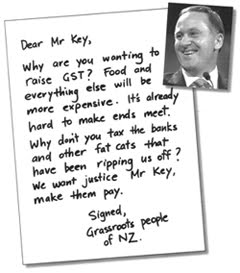
Why are you wanting to raise GST? Food and everything else will be more expensive. It's already hard to make ends meet. Why don't you tax the banks and other fat cats that have been ripping us off? We want justice Mr Key, make them pay.

Signed,
Grassroots people of NZ

“The global financial crisis has inflicted a lot of pain on New Zealanders, with job losses and widespread clamps on wages,” says Vaughan Gunson, Bad Banks spokesperson. “And this pain is being compounded by the Big Four Aussie banks looking after their own equity position. They’ve been forcing mortgagee sales and inflicting penalties on homeowners struggling to meet their mortgage payments.”

“We're sending a message to John Key and the government: it's the banks and other financial fats cats who must be made to pay, not grassroots New Zealanders," says Gunson.

With the letter Bad Banks campaigners are proposing three "common sense" measures that would rein in the banks and deliver real benefits to grassroots people. The three measures are:

1. Stop forced mortgagee sales
Regulatory muscle used to stop banks turfing people out of their homes. A government body to oversee the re-negotiation of mortgages based on current market values and ability of the homeowner to pay.

2. Turn Kiwibank into a proper public bank
Offering 3% interest loans to first home buyers, zero-fee banking for people on modest incomes, and low interest loans to local bodies for sustainable eco-projects in the public good.

3. Introduce a Robin Hood Tax (also known as a Financial Transaction Tax)
A small percentage tax on financial transactions would net billions of dollars from banks and global financial speculators. GST could be phased out.

“We’re inviting New Zealanders to sign on to the letter and support these three demands,” says Gunson. "They're doable, if there's the political will."

People can add their name online by visiting the Bad Banks website www.badbanks.co.nz, or by going directly to http://www.ipetitions.com/petition/badbanks/. People can also make a comment if they wish.

“In a month’s time we’ll be formally forwarding the letter and the full list of people who’ve signed, plus their comments, to the prime minister,” says Gunson.

“We would like to see a debate in New Zealand about why the government is planning to lift GST to 15% in the Budget on 20 May, while the big banks are being allowed to continue making their mega-profits,” says Gunson. “Bad Banks campaigners are up for the debate – is Mr Key?"

See also Bad Banks media release (25 April), Something missing from GST debate: a Robin Hood Tax.

A higher resolution image of the attached graphic for use in print and online publications is available.

For more information and comment, contact

Vaughan Gunson
Bad Banks spokesperson
svpl(at)xtra.co.nz
(09)433 8897
021-0415 082


The 53 public signatories to the letter to Mr Key and the accompanying proposals to rein in the banks and protect grassroots people are:

Moea Armstrong, co-convenor Green Party of Aotearoa/NZ, Whangarei.

James Barber, male co-convenor Greens@Vic, Wellington.

Potaua Biasiny-Tule, TangataWhenua.com, Rotorua.

Nikolasa Biasiny-Tule, TangataWhenua.com, Rotorua.

Victor Billot, communications officer Maritime Union, Dunedin.

Pat Bolster, secretary Unions Wellington.

Sue Bradford, community activist, Auckland.

Grant Brookes, union delegate, Wellington.

Paul Bruce, Greater Wellington Regional Councillor.

Andrew Campbell, union organiser, Wellington.

Joe Carolan, campaigns officer Unite Union & editor SocialistAotearoa.org

Laurence Clark, cartoonist & journalist, Whangarei.

David Colyer, editor UNITYblog, on-line journal of Socialist Worker-New Zealand.

Catherine Delahunty, Green Party List MP, Coromandel Peninsula.

Vincent Eastwood, Guerilla Media, Auckland.

Aaron Edwards, organiser Green Party, Whangarei.

Tony Fala, community worker, Manukau City.

Joe Fleetwood
, general secretary Maritime Union of New Zealand, Wellington.

Quentin Findlay, economic development spokesperson Alliance Party, Christchurch.

Roger Fowler, manager Mangere East Community Learning Centre, Auckland.

Rob George, convenor Unions Waikato, Hamilton.

Vaughan Gunson, spokesperson Bad Banks & national chair Socialist Worker-New Zealand, Whangarei.

Omar Hamed, organiser Unite Union, Wellington.

Bernie Hornfeck, chairperson Rotorua Peoples’ Union.

Murray Horton, secretary/organiser for CAFCA (Campaign Against Foreign Control of Aotearoa), Christchurch.

Tim Howard, community worker, Whangarei.

Peter Hughes, union organiser, Auckland.

Prue Hyman, feminist economist Victoria University, Wellington.

Nik Janiurek, theatre lighting designer, Auckland.

Shafqat Kadri, student MA Applied Language Studies, University of Auckland.

Sydney Keepa, National Distribution Union Apiha Maori & co-convener Kaimahi Maori CTU Runanga,

Daphne Lawless, musician & writer, Auckland.

Dion Martin, organiser National Distribution Union, Palmerston North.

Paul Maunder, writer & community worker.

Matt McCarten, general secretary Unite Union, Auckland.

William (Billy) Mckee, director GreenCross NZ, Levin.

John Minto, community activist, Auckland.

Grant Morgan, international secretary Socialist Worker-New Zealand, Auckland.

Pat O'Dea, electrician & union activist, Auckland.

Hana el Ojeili, student LLB University of Auckland.

Dean Parker, NZ Writers' Guild, Auckland.

Len Parker, manager Socialist Centre, Auckland.

Kristy Pearson, student activist, Dunedin.

Paul Piesse, president Alliance Party, Christchurch.

Robert Popata, organiser Kotahitanga Union, Whangarei.

John Ryall, national secretary Service & Food Workers Union Nga Ringa Tota, Wellington.

Ross Scholes, Democracy activist, Auckland.

Tony Snelling-Berg, Socialist Worker activist, Tauranga.

Fran Strajnar, business owner, Auckland.

Owen Thompson, Unite Union, Auckland.

Mike Treen, national director Unite Union, Auckland.

Sarah Watson, writer & teacher, Wellington.

Oliver Woods, advertising manager, resident Singapore.

*All public signatories do so as individuals, with their positions or brief descriptors included for identification purposes.

**We welcome more community campaigners and prominent people becoming public signatories prior to the letter and accompanying demands being formally sent to the prime minister. Contact Vaughan, email svpl@xtra.co.nz or ph/txt 021-0415 082.

24.4.10

Something missing from GST debate: a Robin Hood Tax

BAD BANKS media release 
25 April 2010


"There’s something missing from the current debate about GST, and that’s a tax alternative, one that targets the banks and financial speculators," says Vaughan Gunson, Bad Banks spokesperson.

"Instead of making food and other basics more expensive for grassroots people, New Zealand needs to introduce a Financial Transaction Tax, or Robin Hood Tax as it’s been named by a popular British campaign," says Gunson.

"A small percentage tax on financial transactions would net billions annually from the big banks and financial speculators, who shift enormous amounts of money around everyday," says Gunson. "We could then remove GST from our food and begin to phase out this horrible regressive tax altogether. This is the circuit breaker that the GST debate needs." 

"Following the global financial implosion, and the role played by the banks and financial speculators, the time is right to introduce a tax which hits the most hated global purveyors of greed and exploitation. Yet the government is heading in the other direction, wanting to give tax breaks to these parasites, while hitting us with a GST increase," says Gunson.

Prime minister John Key wants to reward international financial speculators with tax breaks and other incentives, as part of his dream of turning New Zealand into a financial hub. The plan rests on enticing global investors to New Zealand with the promise of tax breaks. A recent IRD report entitled ‘Allowing a zero per cent tax rate for non-residents investing in a PIE [portfolio investment entity]’ reveals what's being considered. Under this proposal, overseas investors would be allowed to operate in this country and not pay New Zealand tax on their international investments.

"John Key would say that removing GST from food is too complicated - yet it’s not too difficult to change the tax laws to gift more profits to international fat cats?" asks Gunson. "Whose side are you on Mr Key? Hardworking grassroots people or the financial parasites?"

The Bad Banks campaign has drafted a letter to the prime minister on behalf of the grassroots people of New Zealand. It reads:

Dear Mr Key,

Why are you wanting to raise GST? Food and everything else will be more expensive. It's already hard to make ends meet. Why don't you tax the banks and other fat cats that have been ripping us off? We want justice Mr Key, make them pay.

Signed,
Grassroots people of NZ

With the letter the Bad Banks campaign is raising three "common sense" measures to curb banking power and protect grassroots people, which includes introducing a Robin Hood Tax. They are:

1. Stop forced mortgagee sales
Regulatory muscle used to stop banks turfing people out of their homes. A government body to oversee the re-negotiation of mortgages based on current market values and ability of the homeowner to pay.

2. Turn Kiwibank into a proper public bank
Offering 3% interest loans to first home buyers, zero-fee banking for people on modest incomes, and low interest loans to local bodies for sustainable eco-projects in the public good.

3. Introduce a Robin Hood Tax (also known as a Financial Transaction Tax)
A small percentage tax on financial transactions would net billions of dollars from banks and global financial speculators. GST could be phased out.

"We’re inviting people to sign-on electronically to our letter to prime minister John Key via the Bad Banks website www.badbanks.co.nz (or go directly to http://www.ipetitions.com/petition/badbanks/). We think a clear message needs to be sent to the government and John Key that it's the banks and other financial fats cats who must be made to pay," says Gunson.

The cartoon by KLARC accompanying this media release is available to be reproduced in print and web publications. For a bigger resolution image contact Vaughan at the email below.

For more comment, contact

Vaughan Gunson
Bad Banks spokesperson
svpl(at)xtra.co.nz
(09)433 8897
021-0415 082

16.3.10

Bad Banks leaflet #6: MAKE THE BANKS PAY

The latest Bad Banks leaflet is out now (leaflet #6). It features on the front a "letter" to prime minister John Key, which reads:
Dear Mr Key,

Why are you wanting to raise GST? Food and everything else will be more expensive. It's already hard to make ends meet. Why don't you tax the banks and other fat cats that have been ripping us off? We want justice Mr Key, make them pay.

Signed,
Grassroots people of NZ
On the back of the leaflet, under the headline 'Make the Banks Pay' are three demands:
1. Stop forced mortgagee sales
Regulatory muscle used to stop banks turfing people out of their homes. A government body to oversee the re-negotiation of mortgages based on current market values and ability of the homeowner to pay.

2. Turn Kiwibank into a proper public bank
Offering 3% interest loans to first home buyers, zero-fee banking for people on modest incomes, and low interest loans to local bodies for sustainable eco-projects in the public good.

3. Introduce a Robin Hood Tax
(also known as a Financial Transaction Tax)
A small percentage tax on financial transactions would net billions of dollars from banks and global financial speculators. GST could be phased out.
These "common sense" measures to curb banking power and protect grassroots people should hit the mark with people who already have negative attitudes towards the banks, which is the majority of New Zealanders. Early feedback from people on the street to the new leaflet has been positive.


SIGN ON TO OUR "LETTER" TO JOHN KEY

To go with the new leaflet, there's a 'Make the Banks Pay' sign-up sheet where people can give their support to our "letter" to John Key and the three demands.

If you would like bulk copies of Bad Banks leaflet #6 and the 'Make the Banks Pay' sign-up sheet, contact Vaughan svpl(at)xtra.co.nz or 021-0415 082.

Send all completed sign-up sheets to Socialist Worker/Bad Banks, PO Box 13-685, Auckland.


SIGN ON ONLINE

There's an online version of the 'Make the Banks Pay' sign-up. Go to http://www.ipetitions.com/petition/badbanks/ to add your signature. Tell your friends, family and workmates. We want to get as many signatures as possible, to grow the campaign and hopefully get crucial media coverage.

You can also join, and invite others to join, the 'Make the Banks Pay' Facebook group. Go to http://www.facebook.com/#!/group.php?gid=392390694275&ref=ts


IN THE MEDIA AT BUDGET TIME


There's going to be a lot of media coverage either side of the upcoming budget (20 May) about an almost certain hike in GST, as well as other policies the National government will be implementing in response to the global economic crisis. It's possible that the alternative message of the Bad Banks campaign: "make the banks pay, not grassroots people", could break through into the media. That possibility will be increased if we can build some campaign momentum on the ground and online over the next couple of months.

If we work hard we may be able to lift the Bad Banks campaign to the next level. The three "common sense" measures are necessary to curb banking power and protect grassroots people in New Zealand. If we act together we just might be able to deliver a blow to the banks.

In solidarity,

Vaughan Gunson
Bad Banks campaign manager
svpl(at)xtra.co.nz
021-0415 082

2.3.10

We could replace tax on essentials with one on destructive speculation

by Barry Coates
from stuff.co.nz
2 March 2010

Some things seem too good to be true. But sometimes it's because they are good ideas whose time has come. One of those is the proposal to levy a tiny tax on the massive movements of money around the world. It's time our Government looked more closely at it.

Why? Because a financial transactions tax will raise significant revenue without adversely affecting most New Zealanders, support our international obligations and reduce the volatility of our currency. It's a win-win-win.

Instead, our Government's attention has been focused on incremental tax reforms that shuffle taxes from one pocket to the other - lower direct taxes and higher GST. The net effect inevitably seems to be that those on lower incomes bear a greater share of the burden. This is all "business as usual" ignoring some longer-term challenges that we face - reform of the financial sector to curb excessive risk-taking, making the transition to a low-carbon economy, and playing our part in the global effort to eradicate extreme poverty.

The proposed FTT is a levy of 0.05 per cent, on average, applied to the trading of a range of equities, bonds, derivatives and foreign exchange transactions (ie 5 cents for a transaction of $100). Such a tax is predicted to curb a lot of speculative activity, but would still raise NZ$570 billion a year globally.

It sounds like a radical proposal, but it is really like extending GST, at a much reduced rate, to wholesale financial transactions - they are currently exempt. It is supported by Japan and leaders of the three largest EU countries - Gordon Brown, Angela Merkel and Nicolas Sarkozy - along with hundreds of eminent economists, financial regulators like Lord Turner and Paul Volcker, financial traders like George Soros and investment guru Warren Buffet.

An international agreement for all countries to introduce a common FTT at the same time would be ideal. This approach is now being considered by the IMF and G20 countries. It should be supported by our Government. But difficulties in getting such a deal should not prevent countries from moving ahead themselves.

Belgium already runs a limited form of FTT and its banking sector has not suffered. A co-ordinated approach would be preferable, but any government can now introduce a levy on trading of their currency, no matter where the transactions take place. The high level of automation in the banking industry makes administration feasible at a low cost.

Ad Feedback
This tax would miss the average bank customer completely, even those buying foreign currency to travel overseas. It is a tax on wholesale finance - it would apply to the high-volume, high-frequency trading and speculation that sees massive sums of money being transferred at a keystroke. The "casino economy" of global finance has grown rapidly in recent years - international financial transactions are now 60 times the level of world GDP. Unfortunately the real economy is not insulated from its collapses. The financial crisis cost the world a staggering US$11.9 trillion, according to the IMF.

The finance industry is a deliberate target for the FTT. It is the most profitable industry in the world, with profits per employee 26 times as high as other business sectors. And, as we have seen in New Zealand, banks are adept at using legal loopholes and tax havens to avoid paying their fair share of tax. The FTT could generate enough revenue to avoid raising GST, replacing taxes on life's essentials with a tax on socially destructive financial speculation. This is consistent with the principle of taxing activities that we want to discourage, as opposed to taxing productive work or basic necessities.

Nobel-prize-winning economist James Tobin described such a tax as "throwing sand in the wheels" of international currency trading. Some sand may well help reduce the volatility of the New Zealand dollar, which attracts massive trading and speculative attacks - according to the Bank of International Settlements, the Kiwi dollar is the 11th most traded currency, far beyond our role in the real economy.

The proposal put forward by a large coalition of groups internationally, under the banner of the "Robin Hood" tax, is that half of the funds raised would be used domestically to help fund public services and reduce government deficits resulting from the financial crisis. A quarter of the funds would be contributed to support international efforts to overcome extreme poverty in the developing world and support the countries that have suffered most from the financial crisis.

The balance would be used to tackle climate change. It could dramatically reduce the emissions from global deforestation and provide most of the funding that is needed by vulnerable countries, including our Pacific neighbours, to protect themselves and adapt to climate change impacts.

Before we dismiss the idea, consider this: just two minutes of a global FTT could pay for basic healthcare for 100,000 people. Two months of the FTT would provide the funds necessary to get every child on Earth into school.

Our Government should take a close look.

Barry Coates is the executive director of Oxfam New Zealand.

20.2.10

Robin Hood tax has Bono and co all a-quiver

by Finlay MacDonald
from Sunday Star Times
14 February 2010

One should always be wary of seemingly simple solutions to seemingly intractable problems – especially solutions endorsed by Bono. Yet the idea of a "Robin Hood tax" on global financial transactions, despite appearing almost too good to be true and, yes, backed by U2's blathering messiah of world peace himself, really is hard to fault.

From a New Zealand perspective the launch of a fresh campaign for such a tax was beautifully timed, coinciding as it did with the timid revenue tinkering proposed by the prime minister. If you'd found yourself drifting off listening to John Key's uninspiring prescriptions, you could have hopped on YouTube and watched the snakily funny Bill Nighy video in which he plays a smarmy banker failing to justify his opposition to a Robin Hood tax.

Like most bankers and tax experts who thrive on the perceived complexity of their fields, simplicity and common sense is his enemy. The central genius of the Robin Hood idea is that it treats the global financial system for what it really is – an economic activity that can be taxed like anything else. Indeed, since so much of the world's total corporate profits now derive from unproductive speculative trades and other money-go-rounds – a phenomenon sometimes described as the "financialisation" of the economy – it's long overdue for scrutiny.

The idea is not particularly new, but it gained new impetus with the global financial crisis and the debate about longer-term remedies for reckless investment banking and foreign exchange dealing. The primary purpose of such a tax, in fact, would be to take some of the heat out of money markets and reduce exchange rate volatility. As its original proponent James Tobin put it, it would "put sand in the wheels of international finance" by creating a major disincentive to short-term speculative transactions.

One benefit of this – aside from curbing the sort of market panics that trigger major crises and ruin ordinary people's lives – would be the diversion of investment back towards the productive sectors. Also, and not least, it would raise the kind of money that makes a difference to the worthy goals humanity (and Bono) aspires to, like fighting poverty and climate change.

Of course, if successful, such a tax would reduce its own potential revenue base, which is why estimates of what it might generate are problematic. However, given that roughly $1.5 trillion is traded in world currency markets each day, even a significantly reduced amount would yield a hefty annual tax take. And it's not as if anyone is arguing for a regime so punitive it would put forex dealers out of work and shut Lamborghini showrooms. Suggestions of between 0.05 and 0.25 percent could raise between $90 and $300 billion a year, depending on the forecast. According to a report by liberal think tank The New Economics Foundation, quoting previous expert analysis including research by the IMF, a currency transactions tax is administratively and logistically feasible – albeit dependent on international political co-operation.

Well, there had to be a catch. Getting governments to agree on such a policy when they are so much in thrall to their domestic financial lobbies would be about as easy as achieving that other noble goal, world peace. British Prime Minister Gordon Brown advocated such a tax at the G20 meeting late last year and continues to promote the idea. Yet only last month the governor of the Bank of England humiliated him by dismissing the proposal as "bottom of the list" of reform options.

In the US, source of the present crisis (which is far from over), Wall Street has very effectively blocked all attempts at reform, historically and now. It's brazen and shameless – how else to explain a banking sector that could revive its morally obscene bonus culture within months of being bailed out with billions upon billions of public dollars? Expecting such creatures to act other than purely self-interestedly is futile.

Outside the banker bubble, though, there is plenty of support for a Robin Hood tax, including from industry leaders, who actually make and sell stuff.

As the boss of New Zealand fishing giant Sanford said to shareholders just the other day, "A tax on non-trade-related currency transactions could not only earn significant income for the government, it could also result in our exchange rate moving closer to its realistic value and thereby add significant value to the wealth of New Zealanders." Now there's a tax reform plan with genuine vision – precisely why this government and its former merchant banker boss could never come up with it.

finlay.macdonald@star-times.co.nz

The Robin Hood Tax - Video

Bank wholesale guarantee could be ending – time for a new bank tax?

from the gossip...
Finsec Union's unofficial weblog
11 Feb 2010

The New Zealand government is sending signals that its wholesale funding guarantee for banks could be winding down, following a decision to end the similar scheme in Australia.

Finsec Campaigns Director Tali Williams said that any end to the wholesale funding guarantee should be accompanied by a tax like that being discussed in Europe and America in order to ensure that banks are paying their fair share of taxes – given the huge influence and risks they pose to our global and national economies.

“A tax like Obama and other world leaders are proposing would give greater security to our economies.  It would also provide much needed income to address both the impacts of the global financial crisis and pressing needs of many countries to do more to assist their citizens and taxpayers – not less.”

A campaign for a global tax on banks’ financial transactions, dubbed a “Robin Hood” tax, was launched last week by 50 organisations including Oxfam, aid agencies, unions, environmental groups and economists. Actor Bill Nighy fronts a promotional film for the tax – you can check it out at the link below:

http://robinhoodtax.org.uk/

23.12.09

“Time to hit the banks and international speculators with a Financial Transaction Tax”, say Bad Banks campaigners.

Bad Banks media release
24 December 2009

“It’s great news that the Aussie-owned banks have to pay up their unpaid tax,” says Vaughan Gunson, Bad Banks campaign manager. “It’s a defeat for them.” [See NZ Herald article Banks to pay taxman billions]

“It shows that big corporations can be brought into line. While the IRD had the law on its side, we shouldn’t underestimate the role mass public opinion has played in getting the banks to cough up,” says Gunson.

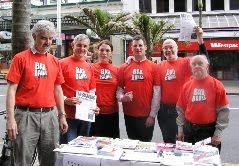
Bad Banks campaigners have been on the streets over the last few months handing out leaflets with information on the banks and the world economic crisis. “We’ve found there’s a real bad mood against the banks,” says Gunson.

“People know the Aussie banks have been making exorbitant profits over the last decade by charging high interest rates for mortgages and credit cards, high fees, and through mega-scale tax avoidance,” says Gunson.

People have been telling us, “Yes, the banks are bad”, “They’re ripping us off big time”, “The banks want to turn us all into debt slaves”.

“And there’s a high level of awareness that it’s the global banking cartels who are responsible for the world economic crisis which is causing large-scale job losses in New Zealand, along with widespread clamps on wages and salaries,” says Gunson.

“The banks and other corporates are trying to make ordinary working people bear the cost of the crisis. We need to resist,” says Gunson.

“To make the big banks and financial speculators pay we’re campaigning for the introduction of a Financial Transaction Tax. A small percentage tax on every financial transaction would net hundreds of millions from banks and international speculators who shift billions and billions of dollars around every year,” says Gunson.

“A tax that targets the mega-rich would allow us to shift the tax burden off low and middle income earners,” says Gunson. “We could take GST off food, which would be a big help to grassroots New Zealanders struggling to pay the bills.”

“Just because the banks have been forced to pay their unpaid tax bill, doesn’t mean they should be let of the hook,” says Gunson. “To protect our people we urgently need major reform of the banking industry.”

To contribute to the national debate that we must have in New Zealand about the banking system, Bad Banks offers these suggestions for transforming the power relationship between banks and the people:

1. Immediate government intervention to stop banks chucking "mum and dad" homeowners out of their homes because of a job loss or income cut.

2. The establishment of a government regulatory body to oversee the renegotiation of mortgages based on realistic market values and the ability of the homeowner to pay.

3. Turn Kiwibank into a proper "public service" bank offering first-home buyers a 3% interest state loan.

4. Zero-fee banking offered to people on modest incomes. Facilitated by expanding the role of Kiwibank and forced regulation of all banks operating in New Zealand .

5. Introduction of a Financial Transaction Tax (FTT) that would net the banks and other financial speculators. A decisive step in shifting the tax burden off low and middle income people and onto the mega-rich.

6. All bank loans to big business over a fixed amount to be approved by a government regulatory body that acts to protect the environment and communities. Such a measure is essential to preventing powerful global banking interests from sabotaging the necessary emergency mobilisation against climate change.

7. A full public inquiry which looks at every aspect of banking operations in New Zealand , with public meetings held throughout the country, so that grassroots people can tell their stories.

For more comment, contact:

Vaughan Gunson
Bad Banks campaign manager
(09)433 8897
021-0415 082
svpl@xtra.co.nz


See also the media release from CAFCA, IRD Delivers Best Possible Xmas Present To Long Suffering Kiwi Taxpayers.


19.12.09

Kiwibank needs to be turned into a proper public bank


The article in the Sunday Star Times, Anger at Kiwibank closures (20 Dec 2009), outlines plans by Kiwibank to close 20 branches nationwide. A cost saving initiative by the bank.

While Kiwibank has tried to market its difference to the Australian owned banks who dominate the banking industry in New Zealand, the reality is that Kiwibank currently doesn't offer much of an alternative. That's because Kiwibank was founded by the government in 2002 to operate as a business, one that has to compete "fairly" with other banks, and at the same time deliver a profit to the government.

The comment in the Sunday Star Time article by Jim Anderton, leader of the Progressive Party and proponent of Kiwibank, reveals the limits of the market model of banking that Kiwibank operates under. Anderton justified the closures on the grounds that this is "what happens with a modern business".

The Bad Banks campaign advocates turning Kiwibank into a proper public bank, as part of major reform of banking in New Zealand. Kiwibank should offer 3% state loans to first home buyers and zero-fee banking to low and middle income people.

This could be financed by raising taxes on the rich, including the introduction of a Financial Transaction Tax (FTT) that nets the banks and other "fat cat" financial speculators that distort the NZ economy.

See Make Kiwibank Public.


10.12.09

"It's the whole banking system which is bananas", say Bad Banks campaigners

Bad Banks media release
10 December 2009

Australian prime minister Kevin Rudd has just given a very public serve to Westpac for an email the bank sent to mortgage customers featuring a cartoon video about selling bananas to justify a big hike in its mortgage rates. (See Westpac goes bananas - http://www.news.com.au/couriermail/story/0,,26462786-3122,00.html.)

"This is just another example of the silly tricks that the Big Four Australian-owned banks (ANZ National, BNZ, Westpac and ASB) are pulling to try and "win over" the public", says Vaughan Gunson, Bad Banks campaign spokesperson.

In New Zealand, BNZ closed the doors of its branches and instructed staff to do community work for a day. And ASB Bank has been pushing an advertising campaign which tries to paint a picture of a "caring bank" that serves us.

"ASB have made the ridiculous claim that they've been a "Kiwi bank since 1847", when in fact they're fully owned by Commonwealth Bank of Australia", says Gunson.

"The banks are trying to "suck up" because they know there's a bad public mood against them, as a result of their interest gouging, fee charging, and tax dodging", says Gunson. "Many New Zealand homeowners are experiencing mortgage stress, thanks to the banks."

"What the Aussie banks are worried about is that the public mood against them will put pressure on governments on both sides of the Tasman to put in place tough regulations that curb their power and rein in their profits", says Gunson.

The Bad Banks campaign is doing its bit to keep the pressure on the banks. Tomorrow (Friday) at 12noon we're going to be outside ASB's Queen Street branch (cnr Wellesley St) with placards and a new leaflet exposing ASB.

"Our aim is to promote a nationwide and popular debate on the banks and their role in the economy", says Gunson. "It goes way beyond a few bad banks, we think the whole banking system is bananas."

"The financial implosion that almost brought down the global economy last year, and which is continuing to wreck havoc on the lives of grassroots people, shows that we need to urgently bring the banks under control", says Gunson.

There is momentum building even amongst the global financial elite for more regulation and control to be imposed on the banks. (See Ex-Fed chief Paul Volcker's 'telling' words on derivatives industry - http://www.telegraph.co.uk/finance/economics/6764177/Ex-Fed-chief-Paul-Volckers-telling-words-on-derivatives-industry.html.)

To contribute to the national debate that we must have in New Zealand about the banking system, Bad Banks offers these suggestions for transforming the power relationship between banks and the people:

1. Immediate government intervention to stop banks turfing "mum and dad" homeowners out of their homes because of a job loss or income cut.

2. The establishment of a government regulatory body to oversee the renegotiation of mortgages based on realistic market values and the ability of the homeowner to pay.

3. Turn Kiwibank into a proper "public service" bank offering first-home buyers a 3% interest state loan.

4. Zero-fee banking offered to people on modest incomes. Facilitated by expanding the role of Kiwibank and forced regulation of all banks operating in New Zealand.

5. Introduction of a Financial Transaction Tax (FTT) that would net the banks and other financial speculators. A decisive step in shifting the tax burden off low and middle income people and onto the mega-rich.

6. All bank loans to big business over a fixed amount to be approved by a government regulatory body that acts to protect the environment and communities. Such a measure is essential to preventing powerful global banking interests from sabotaging the necessary emergency mobilisation against climate change.

7. A full public inquiry which looks at every aspect of banking operations in New Zealand, with public meetings held throughout the country, so that grassroots people can tell their stories.

Contact:

Vaughan Gunson
Bad Banks media spokesperson
(09)433 8897
021-0415 082
svpl@xtra.co.nz

9.11.09

Bad Banks leaflet #4: The Rich Have Stolen the Economy


Bad Banks leaflet #4 is out now. It's been produced to use at stalls outside cinemas showing Michael Moore's new film, Capitalism: A Love Story, which has general release throughout the country.

The leaflet aims to connect with some of the issues raised in the film, in particular the massive government bailouts of the world's biggest banks, but it also points towards a more fundamental crisis of the system. On the back page of the leaflet is Grant Morgan's short-essay, 'Senior investment guru forecasts longrun damage to capitalism's profits'.

At the same time as we provide a "big picture" analysis of the global economic crisis and it's fallout, we need to be looking at what immediate demands the Bad Banks campaign can raise. This leaflet promotes a Financial Transaction Tax (FTT) to net the big banks and other financial speculators. A small percentage tax on financial transactions would easily make up for tax revenue lost as a result of removing GST tax off food, a demand made popular last year by RAM-Residents Action Movement (http://www.ram.org.nz/).

While the leaflet is intended to connect with people attending Michael Moore's new film, it can still be used on other Bad Banks stalls in combination with the leaflets already produced. If you would like bulk copies printed and sent to you, email Len office@sworker.pl.net.


7.11.09

Banks know there's a bad mood rising

The Big Four Australian-owned banks know that the public mood is against them, because, well, they're interest gouging, profit-taking, tax dodgers - there's not much to like!

But they're trying to do the impossible and suck up to us anyway. See the NZ Herald article below, 'Banks: your new best friend'. In the article, the BNZ's person in charge of media spin, Dianne Maxwell, says "Banks just genuinely believe that we need to be a part of the community". That's a hard sell when you've just been caught avoiding $661 million of tax.

This clumsy attempt at sucking up to us could seriously backfire. Most people will see it for what it is, and if we can highlight the banks' deception, perhaps we can turn the mood even more sour against them. And in doing so we can seek to achieve a higher public profile for pro-grassroots policy demands like removing GST off food and introducing a Financial Transaction Tax instead, which would force the banks and other "fat cat" financial speculators to pay a greater share of the tax burden than they do now.

Banks: your new best friend

by Adam Bennett
from NZ Herald
7 November 2009
You may have noticed the big Australian-owned banks trying to cuddle up to you lately.
In one television commercial a big clumsy Westpac guy, prompted by wordless admonitions from a bunch of everyday Kiwis, eventually does the right thing by going to some inconvenience to retrieve his discarded icecream wrapper from the sea.

ASB Bank, on the other hand, is trying to convince people it is one of us, running adverts telling us it has been a "Kiwi bank" since 1847.