by Matt McCarten
from NZ Herald
13 December 2009
The Australian banks last week had their Prime Minister scolding them to take a hard look at themselves. That's because they snuck through an interest rate rise after their Reserve Bank raised its rates.
Westpac was the worst with a 45-point hike, even though the Reserve Bank raised the rate by only 25 points.
Westpac rubbed salt into its customers' wounds by sending them an email comparing the bank's profit-gouging decision to a situation when a tropical storm hits a banana plantation. Apparently, such an occurrence would increase the price of a banana smoothie.
Of course, the comparison was dishonest and patronising.
A bank's unethical profiteering that puts people in a situation of not being able to pay their mortgage is outrageous enough. But comparing it with paying more for a banana smoothie has caused a furore in Australia.
Westpac won't want that public relations disaster following it over here, given it has announced it is making over its New Zealand brand to show how much it cares about us.
The other Australian banks (ANZ, ASB, BNZ and National) have followed with a charm offensive, too. There are lots of soothing words about how they want to get closer to New Zealanders by opening more branch offices and offering more intimate services.
It's a bit hard to understand their strategy, given they recently sacked hundreds of Kiwi bank tellers and shipped their work offshore to call-centre factories. It seems only yesterday we were being told local bank branch closures would save us money.
Despite those rather inconvenient truths, the public relations campaign to win our goodwill is well under way. Recently, BNZ proudly promoted its public spirit credentials by closing its doors for a day and paying its employees to do community work for the day.
I'm not trying to piss on the parade, but the day after, I was in a BNZ bank and the staff were running ragged. One of them dryly noted that BNZ got good publicity, but it also meant the workers had to fit five days' work into four days that week.
One of the BNZ's main competitors, the ASB Bank, is now rebranded as the "caring bank". It also claims to have been a "Kiwi bank since 1847".
I doubt the Commonwealth Bank of Australia is aware of the new change of ownership.
It seems that the new initiatives to win our favour are twofold. Despite the widespread political opposition and scepticism to setting up a publicly owned community, Kiwibank has gone from strength to strength as many New Zealanders have swapped their bank accounts over. Nationalism and sovereignty are strong emotions.
The second reason is the public mood is going dog on them. There's been too much news about interest fixing, exorbitant fees and the outrageous tax evasion cases now before the courts.
That's on top of the increasing numbers of ordinary New Zealanders losing their homes as the banks start foreclosing on them.
Vaughan Gunson from the Bad Bank campaign claims the Australian bank owners are terrified that the public sentiments will lead to politicians on both sides of the Tasman following their American colleagues and regulating the industry to curb its excessive profiteering. Gunson blames the banks for causing the financial crisis that almost collapsed the global economy.
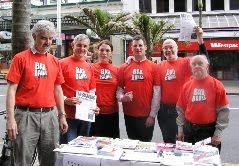
The Bad Bank supporters picketed a bank in downtown Auckland on Friday as part of their campaign to force the Government to hold a formal inquiry into the role of banks in this country.
Westpac ran a stupid banana campaign, says Gunson, but the whole world banking system has gone bananas. One slip on a skin and we're all gone.
The Government's siding with the Australian bank owners in not holding an inquiry makes me nervous.
Showing posts with label Aussie-owned banks. Show all posts
10.12.09
"It's the whole banking system which is bananas", say Bad Banks campaigners
Bad Banks media release
10 December 2009
Australian prime minister Kevin Rudd has just given a very public serve to Westpac for an email the bank sent to mortgage customers featuring a cartoon video about selling bananas to justify a big hike in its mortgage rates. (See Westpac goes bananas - http://www.news.com.au/couriermail/story/0,,26462786-3122,00.html.)
"This is just another example of the silly tricks that the Big Four Australian-owned banks (ANZ National, BNZ, Westpac and ASB) are pulling to try and "win over" the public", says Vaughan Gunson, Bad Banks campaign spokesperson.
In New Zealand, BNZ closed the doors of its branches and instructed staff to do community work for a day. And ASB Bank has been pushing an advertising campaign which tries to paint a picture of a "caring bank" that serves us.
"ASB have made the ridiculous claim that they've been a "Kiwi bank since 1847", when in fact they're fully owned by Commonwealth Bank of Australia", says Gunson.
"The banks are trying to "suck up" because they know there's a bad public mood against them, as a result of their interest gouging, fee charging, and tax dodging", says Gunson. "Many New Zealand homeowners are experiencing mortgage stress, thanks to the banks."
"What the Aussie banks are worried about is that the public mood against them will put pressure on governments on both sides of the Tasman to put in place tough regulations that curb their power and rein in their profits", says Gunson.
The Bad Banks campaign is doing its bit to keep the pressure on the banks. Tomorrow (Friday) at 12noon we're going to be outside ASB's Queen Street branch (cnr Wellesley St) with placards and a new leaflet exposing ASB.
"Our aim is to promote a nationwide and popular debate on the banks and their role in the economy", says Gunson. "It goes way beyond a few bad banks, we think the whole banking system is bananas."
"The financial implosion that almost brought down the global economy last year, and which is continuing to wreck havoc on the lives of grassroots people, shows that we need to urgently bring the banks under control", says Gunson.
There is momentum building even amongst the global financial elite for more regulation and control to be imposed on the banks. (See Ex-Fed chief Paul Volcker's 'telling' words on derivatives industry - http://www.telegraph.co.uk/finance/economics/6764177/Ex-Fed-chief-Paul-Volckers-telling-words-on-derivatives-industry.html.)
To contribute to the national debate that we must have in New Zealand about the banking system, Bad Banks offers these suggestions for transforming the power relationship between banks and the people:
1. Immediate government intervention to stop banks turfing "mum and dad" homeowners out of their homes because of a job loss or income cut.
2. The establishment of a government regulatory body to oversee the renegotiation of mortgages based on realistic market values and the ability of the homeowner to pay.
3. Turn Kiwibank into a proper "public service" bank offering first-home buyers a 3% interest state loan.
4. Zero-fee banking offered to people on modest incomes. Facilitated by expanding the role of Kiwibank and forced regulation of all banks operating in New Zealand.
5. Introduction of a Financial Transaction Tax (FTT) that would net the banks and other financial speculators. A decisive step in shifting the tax burden off low and middle income people and onto the mega-rich.
6. All bank loans to big business over a fixed amount to be approved by a government regulatory body that acts to protect the environment and communities. Such a measure is essential to preventing powerful global banking interests from sabotaging the necessary emergency mobilisation against climate change.
7. A full public inquiry which looks at every aspect of banking operations in New Zealand, with public meetings held throughout the country, so that grassroots people can tell their stories.
Contact:
Vaughan Gunson
Bad Banks media spokesperson
(09)433 8897
021-0415 082
svpl@xtra.co.nz
10 December 2009
Australian prime minister Kevin Rudd has just given a very public serve to Westpac for an email the bank sent to mortgage customers featuring a cartoon video about selling bananas to justify a big hike in its mortgage rates. (See Westpac goes bananas - http://www.news.com.au/couriermail/story/0,,26462786-3122,00.html.)
"This is just another example of the silly tricks that the Big Four Australian-owned banks (ANZ National, BNZ, Westpac and ASB) are pulling to try and "win over" the public", says Vaughan Gunson, Bad Banks campaign spokesperson.
In New Zealand, BNZ closed the doors of its branches and instructed staff to do community work for a day. And ASB Bank has been pushing an advertising campaign which tries to paint a picture of a "caring bank" that serves us.
"ASB have made the ridiculous claim that they've been a "Kiwi bank since 1847", when in fact they're fully owned by Commonwealth Bank of Australia", says Gunson.
"The banks are trying to "suck up" because they know there's a bad public mood against them, as a result of their interest gouging, fee charging, and tax dodging", says Gunson. "Many New Zealand homeowners are experiencing mortgage stress, thanks to the banks."
"What the Aussie banks are worried about is that the public mood against them will put pressure on governments on both sides of the Tasman to put in place tough regulations that curb their power and rein in their profits", says Gunson.
The Bad Banks campaign is doing its bit to keep the pressure on the banks. Tomorrow (Friday) at 12noon we're going to be outside ASB's Queen Street branch (cnr Wellesley St) with placards and a new leaflet exposing ASB.
"Our aim is to promote a nationwide and popular debate on the banks and their role in the economy", says Gunson. "It goes way beyond a few bad banks, we think the whole banking system is bananas."
"The financial implosion that almost brought down the global economy last year, and which is continuing to wreck havoc on the lives of grassroots people, shows that we need to urgently bring the banks under control", says Gunson.
There is momentum building even amongst the global financial elite for more regulation and control to be imposed on the banks. (See Ex-Fed chief Paul Volcker's 'telling' words on derivatives industry - http://www.telegraph.co.uk/finance/economics/6764177/Ex-Fed-chief-Paul-Volckers-telling-words-on-derivatives-industry.html.)
To contribute to the national debate that we must have in New Zealand about the banking system, Bad Banks offers these suggestions for transforming the power relationship between banks and the people:
1. Immediate government intervention to stop banks turfing "mum and dad" homeowners out of their homes because of a job loss or income cut.
2. The establishment of a government regulatory body to oversee the renegotiation of mortgages based on realistic market values and the ability of the homeowner to pay.
3. Turn Kiwibank into a proper "public service" bank offering first-home buyers a 3% interest state loan.
4. Zero-fee banking offered to people on modest incomes. Facilitated by expanding the role of Kiwibank and forced regulation of all banks operating in New Zealand.
5. Introduction of a Financial Transaction Tax (FTT) that would net the banks and other financial speculators. A decisive step in shifting the tax burden off low and middle income people and onto the mega-rich.
6. All bank loans to big business over a fixed amount to be approved by a government regulatory body that acts to protect the environment and communities. Such a measure is essential to preventing powerful global banking interests from sabotaging the necessary emergency mobilisation against climate change.
7. A full public inquiry which looks at every aspect of banking operations in New Zealand, with public meetings held throughout the country, so that grassroots people can tell their stories.
Contact:
Vaughan Gunson
Bad Banks media spokesperson
(09)433 8897
021-0415 082
svpl@xtra.co.nz
Bad Banks exposure of ASB's "Kiwi bank" claim - 12noon, Friday 11 December
Bad Banks media release
7 December 2009
http://www.badbanks.co.nz/
Bad Banks campaigners will be outside ASB Bank on Queen Street (cnr Wellesley St), Auckland, this Friday to expose ASB's claim that it's a "Kiwi bank".
"ASB ain't no Kiwi bank," says Vaughan Gunson, Bad Banks media spokesperson. "They're 100% owned by the Commonwealth Bank of Australia, one of the bigger banks in the world. They're misleading the New Zealand public, to say the least."
"We find their recent advertising campaign hard to stomach, and I'm sure many people feel the same," says Gunson, "because ASB and the other Aussie-owned banks (ANZ National, BNZ, and Westpac) aren't serving our interests at all. Their only goal is to make as much money as possible for bank bosses and corporate shareholders."
"The Aussie-owned banks have been making exorbitant profits for years from high interest rates on mortgages and credit cards, as well as imposing high fees and late penalties. They've been hurting grassroots New Zealanders," says Gunson.
"And now with the recession and people struggling to pay the bills, the banks are out to protect their own equity position by forcing mortgagee sales in record numbers," says Gunson.
On top of these injustices, ASB is refusing to pay an unpaid tax bill of $285 million. "Rather than big-budget advertising campaigns designed to mislead us, ASB bosses should just pay up the tax they owe," says Gunson.
"It's obvious that ASB and the other big banks are trying to suck up to us. Why? Because they're worried that the bad public mood against them will result in the government being forced to curb banking power and rein in their profits. Which is exactly what the Bad Banks campaign wants to see, " says Gunson.
"We've started a long term campaign to build pressure on the banks, which we hope will result in tougher regulations being placed on the banking and finance industries. Most people would say it can't happen too soon," says Gunson.
Bad Banks campaigners recently nominated ASB Bank for the 2009 Roger Award, given annually to the "Worst Transnational Corporation Operating in Aotearoa/New Zealand" (see Backgrounder #2 below).
"It was difficult to choose which bank to nominate for The Roger Award, because in the eyes of most New Zealanders all banks are bad," says Gunson. "But what tipped the balance in favour of ASB, was the fact that ASB bosses have been very hostile to the bank workers union, Finsec."
"Today, ASB is the only big bank which is not unionised. Which begs the question: is it "Kiwi" to be anti-union?" asks Gunson.
Bad Banks campaigners will be carrying placards, making some noise, and handing out leaflets to the public outside the Queen Street branch of ASB Bank at 12noon, this Friday, 11 December. Media are invited to attend to get more comment, plus photos/footage.
The cartoon image attached to this media release is by ex-NZ Herald cartoonist, KLARC. It is freely available for reproduction on websites or in print publications.
For more comment, contact:
Vaughan Gunson
Bad Banks media spokesperson
(09)433 8897
021-0415 082
svpl@xtra.co.nz
________________________________________
Backgrounder #1
The Bad Banks campaign has been initiated by Socialist Worker-New Zealand. We believe the banks in New Zealand and globally have grown to exercise enormous and dangerous power over the economy. The big banks and their government backers are driving forward economic policies that threaten people and planet.
There are a range of measures needed to stop the banks, from tough government regulations to establishing proper public banks which provide credit as a service rather than to make a profit.
The Bad Banks campaign also advocates measures like a Financial Transaction Tax (FTT) to net the banks and other financial speculators whose profits from wheeling and dealing goes largely untaxed. Such a tax would allow New Zealand to move towards a fairer tax system which shifts the tax burden off low and middle income people and onto the big wealthy corporates.
For more information on the Bad Banks campaign go to http://www.badbanks.co.nz/
Backgrounder #2
These were the 10 reasons given by Bad Banks campaigners for why ASB deserved to receive the 2009 Roger Award:
1. Interest gouging grassroots Kiwi homeowners.
Mortgage holders know it. Even the Reserve Bank in 2009 came out and said that the banks, including ASB, were keeping their interest rates too high. High interest rates on large mortgages put modest income earners under considerable financial stress in 2009, as many were affected by job losses, income cuts, and general financial insecurity. (See http://www.nzherald.co.nz/interest-rates/news/article.cfm?c_id=235&objectid=10582846)
2. Foreclosing on people's homes.
2009 saw record numbers of mortgagee sales, as banks moved to protect their own equity position by turfing increasing numbers of "mum and dad" mortgage holders out of their homes. Hundreds of homeowners were foreclosed in Auckland, ASB's home turf. (See http://business.scoop.co.nz/2009/09/28/record-high-for-mortgagee-sales-despite-recovery)
3. Continuing to make massive profits at the expense of grassroots people.
The recession of 2008/09 did not prevent ASB making a big profit, $238 million for the first six months of the financial year. Such a high profit in a recession points to the power the bank has to shift the burden of economic hard times on to ordinary New Zealanders. (See http://tvnz.co.nz/business-news/asb-tax-operating-profit-down-2477075)
4. Mega-scale tax dodging.
It came to public attention in 2009 the full extent of tax dodging by the Big Four Aussie-owned banks, over $2 billion. The IRD is after $285 million from ASB for unpaid tax between 2001 and 2004. Having been caught, ASB bosses are still refusing to pay up, and will likely use teams of expensive lawyers to drag the process through the courts, costing the IRD and the Crown millions. (See http://www.nbr.co.nz/article/asb-estimates-285-million-exposure-nz-tax-case-113373)
5. Failing to face up to public scrutiny.
Nobody from ASB Bank fronted up to the parliamentary inquiry into the operations of the banks organised by the Green, Labour and Progressive parties in 2009. While this inquiry had no teeth, because it was not supported by the National government, this disregard for the New Zealand public showed how arrogant and conceited is the position of the Aussie-owned banks. (See http://www.scoop.co.nz/stories/PA0909/S00049.htm)
6. Union busting.
The ASB Bank has determinedly used anti-union practices to stop Finsec Union from organising bank workers. To inquire more about ASB's union busting you could contact Finsec Union directly, phone 04 385 7723, email union@finsec.org.nz.
7. Imposing a wage freeze on workers.
All ASB Bank employees earning over $50,000 have been informed this year that they will be subject to a wage freeze. This will affect 3,500 of the bank's 4,700 staff nationwide. The low bar compares unfavourably with that being used by ASB's parent company in Australia, Commonwealth Bank, where the wage freeze is for staff earning over $100,000. (See http://finsec.wordpress.com/2009/04/24/asb-bank-freeze-staff-wages-%E2%80%93-no-union-members-to-stop-it/)
8. Deceiving New Zealanders by claiming to be a "Kiwi Bank".
ASB advertisements in October 2009 used the phrase "we've been a KIWI BANK since 1847", when in fact ASB is almost entirely Aussie owned. The phrase cynically seeks to convey the impression that the ASB Bank operates in the interests of New Zealanders, when its corporate practices plainly tell another story. (See http://www.nzherald.co.nz/sideswipe/news/article.cfm?c_id=702&objectid=10604600)
9. Cutting funding to community groups.
Just when many community organisations needed it most, to deal with the human fallout of the recession, ASB Bank, through its ASB Charitable Trust, froze grants for six months in 2009. This is despite continuing to make big profits. (See http://www.nzherald.co.nz/business/news/article.cfm?c_id=3&objectid=10603631)
10. Using the media to frame public debate in a way that's advantageous to banks.
Any search of news websites like NZ Herald or Stuff for "ASB" reveals just how often spokespeople for the bank are in the media. The bank produced a constant stream of statements and commentary on economic indicators, which are clearly designed to frame media debate on economic issues in a way that's favorable to banking operations.
For more information on CAFCA (Campaign Against Foreign Control of Aotearoa) and The Roger Award go to http://canterbury.cyberplace.co.nz/community/CAFCA/
(Note ASB was not one of The Roger Award finalists recently announced by CAFCA)
7 December 2009
http://www.badbanks.co.nz/
Bad Banks campaigners will be outside ASB Bank on Queen Street (cnr Wellesley St), Auckland, this Friday to expose ASB's claim that it's a "Kiwi bank".
"ASB ain't no Kiwi bank," says Vaughan Gunson, Bad Banks media spokesperson. "They're 100% owned by the Commonwealth Bank of Australia, one of the bigger banks in the world. They're misleading the New Zealand public, to say the least."
"We find their recent advertising campaign hard to stomach, and I'm sure many people feel the same," says Gunson, "because ASB and the other Aussie-owned banks (ANZ National, BNZ, and Westpac) aren't serving our interests at all. Their only goal is to make as much money as possible for bank bosses and corporate shareholders."
"The Aussie-owned banks have been making exorbitant profits for years from high interest rates on mortgages and credit cards, as well as imposing high fees and late penalties. They've been hurting grassroots New Zealanders," says Gunson.
"And now with the recession and people struggling to pay the bills, the banks are out to protect their own equity position by forcing mortgagee sales in record numbers," says Gunson.
On top of these injustices, ASB is refusing to pay an unpaid tax bill of $285 million. "Rather than big-budget advertising campaigns designed to mislead us, ASB bosses should just pay up the tax they owe," says Gunson.
"It's obvious that ASB and the other big banks are trying to suck up to us. Why? Because they're worried that the bad public mood against them will result in the government being forced to curb banking power and rein in their profits. Which is exactly what the Bad Banks campaign wants to see, " says Gunson.
"We've started a long term campaign to build pressure on the banks, which we hope will result in tougher regulations being placed on the banking and finance industries. Most people would say it can't happen too soon," says Gunson.
Bad Banks campaigners recently nominated ASB Bank for the 2009 Roger Award, given annually to the "Worst Transnational Corporation Operating in Aotearoa/New Zealand" (see Backgrounder #2 below).
"It was difficult to choose which bank to nominate for The Roger Award, because in the eyes of most New Zealanders all banks are bad," says Gunson. "But what tipped the balance in favour of ASB, was the fact that ASB bosses have been very hostile to the bank workers union, Finsec."
"Today, ASB is the only big bank which is not unionised. Which begs the question: is it "Kiwi" to be anti-union?" asks Gunson.
Bad Banks campaigners will be carrying placards, making some noise, and handing out leaflets to the public outside the Queen Street branch of ASB Bank at 12noon, this Friday, 11 December. Media are invited to attend to get more comment, plus photos/footage.
The cartoon image attached to this media release is by ex-NZ Herald cartoonist, KLARC. It is freely available for reproduction on websites or in print publications.
For more comment, contact:
Vaughan Gunson
Bad Banks media spokesperson
(09)433 8897
021-0415 082
svpl@xtra.co.nz
________________________________________
Backgrounder #1
The Bad Banks campaign has been initiated by Socialist Worker-New Zealand. We believe the banks in New Zealand and globally have grown to exercise enormous and dangerous power over the economy. The big banks and their government backers are driving forward economic policies that threaten people and planet.
There are a range of measures needed to stop the banks, from tough government regulations to establishing proper public banks which provide credit as a service rather than to make a profit.
The Bad Banks campaign also advocates measures like a Financial Transaction Tax (FTT) to net the banks and other financial speculators whose profits from wheeling and dealing goes largely untaxed. Such a tax would allow New Zealand to move towards a fairer tax system which shifts the tax burden off low and middle income people and onto the big wealthy corporates.
For more information on the Bad Banks campaign go to http://www.badbanks.co.nz/
Backgrounder #2
These were the 10 reasons given by Bad Banks campaigners for why ASB deserved to receive the 2009 Roger Award:
1. Interest gouging grassroots Kiwi homeowners.
Mortgage holders know it. Even the Reserve Bank in 2009 came out and said that the banks, including ASB, were keeping their interest rates too high. High interest rates on large mortgages put modest income earners under considerable financial stress in 2009, as many were affected by job losses, income cuts, and general financial insecurity. (See http://www.nzherald.co.nz/interest-rates/news/article.cfm?c_id=235&objectid=10582846)
2. Foreclosing on people's homes.
2009 saw record numbers of mortgagee sales, as banks moved to protect their own equity position by turfing increasing numbers of "mum and dad" mortgage holders out of their homes. Hundreds of homeowners were foreclosed in Auckland, ASB's home turf. (See http://business.scoop.co.nz/2009/09/28/record-high-for-mortgagee-sales-despite-recovery)
3. Continuing to make massive profits at the expense of grassroots people.
The recession of 2008/09 did not prevent ASB making a big profit, $238 million for the first six months of the financial year. Such a high profit in a recession points to the power the bank has to shift the burden of economic hard times on to ordinary New Zealanders. (See http://tvnz.co.nz/business-news/asb-tax-operating-profit-down-2477075)
4. Mega-scale tax dodging.
It came to public attention in 2009 the full extent of tax dodging by the Big Four Aussie-owned banks, over $2 billion. The IRD is after $285 million from ASB for unpaid tax between 2001 and 2004. Having been caught, ASB bosses are still refusing to pay up, and will likely use teams of expensive lawyers to drag the process through the courts, costing the IRD and the Crown millions. (See http://www.nbr.co.nz/article/asb-estimates-285-million-exposure-nz-tax-case-113373)
5. Failing to face up to public scrutiny.
Nobody from ASB Bank fronted up to the parliamentary inquiry into the operations of the banks organised by the Green, Labour and Progressive parties in 2009. While this inquiry had no teeth, because it was not supported by the National government, this disregard for the New Zealand public showed how arrogant and conceited is the position of the Aussie-owned banks. (See http://www.scoop.co.nz/stories/PA0909/S00049.htm)
6. Union busting.
The ASB Bank has determinedly used anti-union practices to stop Finsec Union from organising bank workers. To inquire more about ASB's union busting you could contact Finsec Union directly, phone 04 385 7723, email union@finsec.org.nz.
7. Imposing a wage freeze on workers.
All ASB Bank employees earning over $50,000 have been informed this year that they will be subject to a wage freeze. This will affect 3,500 of the bank's 4,700 staff nationwide. The low bar compares unfavourably with that being used by ASB's parent company in Australia, Commonwealth Bank, where the wage freeze is for staff earning over $100,000. (See http://finsec.wordpress.com/2009/04/24/asb-bank-freeze-staff-wages-%E2%80%93-no-union-members-to-stop-it/)
8. Deceiving New Zealanders by claiming to be a "Kiwi Bank".
ASB advertisements in October 2009 used the phrase "we've been a KIWI BANK since 1847", when in fact ASB is almost entirely Aussie owned. The phrase cynically seeks to convey the impression that the ASB Bank operates in the interests of New Zealanders, when its corporate practices plainly tell another story. (See http://www.nzherald.co.nz/sideswipe/news/article.cfm?c_id=702&objectid=10604600)
9. Cutting funding to community groups.
Just when many community organisations needed it most, to deal with the human fallout of the recession, ASB Bank, through its ASB Charitable Trust, froze grants for six months in 2009. This is despite continuing to make big profits. (See http://www.nzherald.co.nz/business/news/article.cfm?c_id=3&objectid=10603631)
10. Using the media to frame public debate in a way that's advantageous to banks.
Any search of news websites like NZ Herald or Stuff for "ASB" reveals just how often spokespeople for the bank are in the media. The bank produced a constant stream of statements and commentary on economic indicators, which are clearly designed to frame media debate on economic issues in a way that's favorable to banking operations.
For more information on CAFCA (Campaign Against Foreign Control of Aotearoa) and The Roger Award go to http://canterbury.cyberplace.co.nz/community/CAFCA/
(Note ASB was not one of The Roger Award finalists recently announced by CAFCA)
26.11.09
Are New Zealand's major banks sound?
by Grant Morgan
International credit rating agency Standard & Poor says that all Australian banks have "insufficient funds to cover their lending exposures", reports the Sydney Morning Herald on 25 November 2009.
No Australian banks were included in the handful that Standard & Poor believe meet the minimum threshold to be considered safe for depositors.
Given that Australian banks own all major New Zealand banks, this news is hugely significant for the Bad Banks campaign in Aotearoa.
The Standard & Poor analysis points towards the financial unsoundness of Australian-owned banks in New Zealand. See Australian banks fail new capital test.
International credit rating agency Standard & Poor says that all Australian banks have "insufficient funds to cover their lending exposures", reports the Sydney Morning Herald on 25 November 2009.
No Australian banks were included in the handful that Standard & Poor believe meet the minimum threshold to be considered safe for depositors.
Given that Australian banks own all major New Zealand banks, this news is hugely significant for the Bad Banks campaign in Aotearoa.
The Standard & Poor analysis points towards the financial unsoundness of Australian-owned banks in New Zealand. See Australian banks fail new capital test.
Australian banks fail new capital test
by Eric Johnston
Sydney Morning Herald
25 November 2009
RATINGS agency Standard & Poor's has warned that nearly all the world's big banks - including Australia's major lenders - have insufficient funds to cover their lending exposures and risk a ratings downgrade unless they move to bolster their balance sheets over the next 18 months.
The warning follows the release of a tougher global measure of bank capital by Standard & Poor's, which has found that most large banks do not meet the minimum 8 per cent threshold under the credit ratings agency's new risk-adjusted capital ratio.
The findings appear to be out of step with claims by Australian banks that they are among the strongest in the world under the traditional measure of bank capital known as the tier 1 ratio.
Over the past year, Australian banks have raised more than $20 billion in new capital to strengthen their balance sheets. This has resulted in an increase in the average tier 1 ratio of the big four banks to 8.9 per cent from 7.8 per cent a year ago.
But critics warn that these measures of tier 1 can be misleading because they fail to distinguish between higher-risk and lower-risk forms of lending. As well, the tier 1 measure is not consistently calculated on an international level.
Australian banks argue that their capital ratios would increase by about 2 per cent on average if they were calculated under existing British rules.
Under the new measure, S&P gives a lower rating to hybrid capital because it behaves more like debt than equity. For Australian banks, hybrid securities can make up to a quarter of their total capital. Specific exposures including trading desks and private equity would require banks to significantly increase the level of capital.
S&P reviewed 45 banks around the world under its new risk-adjusted measure. No Australian banks were included in the handful that hit the minimum threshold to be considered safe.
Of three local lenders included in the review, ANZ scored the highest rating with 7.1 per cent. National Australia Bank was at 6.9 per cent and Commonwealth Bank at 6.3 per cent.
While Australian banks benefited from having a large exposure to low-risk residential mortgages, S&P said a narrow geographic and business base counted as a negative. It also noted that the capital raisings by the local banks had been used mainly to fund acquisitions or balance sheet growth.
Among the global banks considered most vulnerable are Mizuho Financial (2 per cent), Citigroup (2.1), UBS (2.2) and Sumitomo Mitsui (3.5). The global average came in at 6.7 per cent.
''The results to date appear to confirm our view that capital is a rating weakness for a majority of banks in our sample,'' S&P said.
The ratings agency said it expected banks to continue strengthening their capital ratios over the next 18 months to comply with tougher regulatory standards. ''Failure to achieve this could put renewed pressure on ratings,'' it said.
The top-rated global bank is HSBC on 9.2 per cent, followed by Dexia on 9 per cent and ING on 8.9 per cent.
The review of capital strength comes as Australian banks face a crackdown on rules related to liquidity.
Subscribe to:
Posts (Atom)