Showing posts with label Kiwibank. Show all posts

12.5.10

Activists send message to Key: “Make the banks pay!”

Bad Banks media release
13 May 2010

Prominent New Zealand activists and unionists are among the 53 public signatories to a letter to prime minister John Key calling for action to curb banking power and protect grassroots people. The full list of public signatories is included below.

The letter, written on behalf of grassroots people in New Zealand, reads:

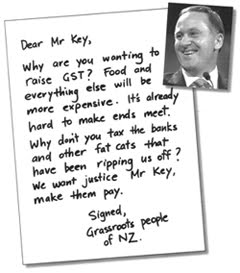
Dear Mr Key,

Why are you wanting to raise GST? Food and everything else will be more expensive. It's already hard to make ends meet. Why don't you tax the banks and other fat cats that have been ripping us off? We want justice Mr Key, make them pay.

Signed,
Grassroots people of NZ

“The global financial crisis has inflicted a lot of pain on New Zealanders, with job losses and widespread clamps on wages,” says Vaughan Gunson, Bad Banks spokesperson. “And this pain is being compounded by the Big Four Aussie banks looking after their own equity position. They’ve been forcing mortgagee sales and inflicting penalties on homeowners struggling to meet their mortgage payments.”

“We're sending a message to John Key and the government: it's the banks and other financial fats cats who must be made to pay, not grassroots New Zealanders," says Gunson.

With the letter Bad Banks campaigners are proposing three "common sense" measures that would rein in the banks and deliver real benefits to grassroots people. The three measures are:

1. Stop forced mortgagee sales
Regulatory muscle used to stop banks turfing people out of their homes. A government body to oversee the re-negotiation of mortgages based on current market values and ability of the homeowner to pay.

2. Turn Kiwibank into a proper public bank
Offering 3% interest loans to first home buyers, zero-fee banking for people on modest incomes, and low interest loans to local bodies for sustainable eco-projects in the public good.

3. Introduce a Robin Hood Tax (also known as a Financial Transaction Tax)
A small percentage tax on financial transactions would net billions of dollars from banks and global financial speculators. GST could be phased out.

“We’re inviting New Zealanders to sign on to the letter and support these three demands,” says Gunson. "They're doable, if there's the political will."

People can add their name online by visiting the Bad Banks website www.badbanks.co.nz, or by going directly to http://www.ipetitions.com/petition/badbanks/. People can also make a comment if they wish.

“In a month’s time we’ll be formally forwarding the letter and the full list of people who’ve signed, plus their comments, to the prime minister,” says Gunson.

“We would like to see a debate in New Zealand about why the government is planning to lift GST to 15% in the Budget on 20 May, while the big banks are being allowed to continue making their mega-profits,” says Gunson. “Bad Banks campaigners are up for the debate – is Mr Key?"

See also Bad Banks media release (25 April), Something missing from GST debate: a Robin Hood Tax.

A higher resolution image of the attached graphic for use in print and online publications is available.

For more information and comment, contact

Vaughan Gunson
Bad Banks spokesperson
svpl(at)xtra.co.nz
(09)433 8897
021-0415 082


The 53 public signatories to the letter to Mr Key and the accompanying proposals to rein in the banks and protect grassroots people are:

Moea Armstrong, co-convenor Green Party of Aotearoa/NZ, Whangarei.

James Barber, male co-convenor Greens@Vic, Wellington.

Potaua Biasiny-Tule, TangataWhenua.com, Rotorua.

Nikolasa Biasiny-Tule, TangataWhenua.com, Rotorua.

Victor Billot, communications officer Maritime Union, Dunedin.

Pat Bolster, secretary Unions Wellington.

Sue Bradford, community activist, Auckland.

Grant Brookes, union delegate, Wellington.

Paul Bruce, Greater Wellington Regional Councillor.

Andrew Campbell, union organiser, Wellington.

Joe Carolan, campaigns officer Unite Union & editor SocialistAotearoa.org

Laurence Clark, cartoonist & journalist, Whangarei.

David Colyer, editor UNITYblog, on-line journal of Socialist Worker-New Zealand.

Catherine Delahunty, Green Party List MP, Coromandel Peninsula.

Vincent Eastwood, Guerilla Media, Auckland.

Aaron Edwards, organiser Green Party, Whangarei.

Tony Fala, community worker, Manukau City.

Joe Fleetwood
, general secretary Maritime Union of New Zealand, Wellington.

Quentin Findlay, economic development spokesperson Alliance Party, Christchurch.

Roger Fowler, manager Mangere East Community Learning Centre, Auckland.

Rob George, convenor Unions Waikato, Hamilton.

Vaughan Gunson, spokesperson Bad Banks & national chair Socialist Worker-New Zealand, Whangarei.

Omar Hamed, organiser Unite Union, Wellington.

Bernie Hornfeck, chairperson Rotorua Peoples’ Union.

Murray Horton, secretary/organiser for CAFCA (Campaign Against Foreign Control of Aotearoa), Christchurch.

Tim Howard, community worker, Whangarei.

Peter Hughes, union organiser, Auckland.

Prue Hyman, feminist economist Victoria University, Wellington.

Nik Janiurek, theatre lighting designer, Auckland.

Shafqat Kadri, student MA Applied Language Studies, University of Auckland.

Sydney Keepa, National Distribution Union Apiha Maori & co-convener Kaimahi Maori CTU Runanga,

Daphne Lawless, musician & writer, Auckland.

Dion Martin, organiser National Distribution Union, Palmerston North.

Paul Maunder, writer & community worker.

Matt McCarten, general secretary Unite Union, Auckland.

William (Billy) Mckee, director GreenCross NZ, Levin.

John Minto, community activist, Auckland.

Grant Morgan, international secretary Socialist Worker-New Zealand, Auckland.

Pat O'Dea, electrician & union activist, Auckland.

Hana el Ojeili, student LLB University of Auckland.

Dean Parker, NZ Writers' Guild, Auckland.

Len Parker, manager Socialist Centre, Auckland.

Kristy Pearson, student activist, Dunedin.

Paul Piesse, president Alliance Party, Christchurch.

Robert Popata, organiser Kotahitanga Union, Whangarei.

John Ryall, national secretary Service & Food Workers Union Nga Ringa Tota, Wellington.

Ross Scholes, Democracy activist, Auckland.

Tony Snelling-Berg, Socialist Worker activist, Tauranga.

Fran Strajnar, business owner, Auckland.

Owen Thompson, Unite Union, Auckland.

Mike Treen, national director Unite Union, Auckland.

Sarah Watson, writer & teacher, Wellington.

Oliver Woods, advertising manager, resident Singapore.

*All public signatories do so as individuals, with their positions or brief descriptors included for identification purposes.

**We welcome more community campaigners and prominent people becoming public signatories prior to the letter and accompanying demands being formally sent to the prime minister. Contact Vaughan, email svpl@xtra.co.nz or ph/txt 021-0415 082.

16.3.10

Bad Banks leaflet #6: MAKE THE BANKS PAY

The latest Bad Banks leaflet is out now (leaflet #6). It features on the front a "letter" to prime minister John Key, which reads:
Dear Mr Key,

Why are you wanting to raise GST? Food and everything else will be more expensive. It's already hard to make ends meet. Why don't you tax the banks and other fat cats that have been ripping us off? We want justice Mr Key, make them pay.

Signed,
Grassroots people of NZ
On the back of the leaflet, under the headline 'Make the Banks Pay' are three demands:
1. Stop forced mortgagee sales
Regulatory muscle used to stop banks turfing people out of their homes. A government body to oversee the re-negotiation of mortgages based on current market values and ability of the homeowner to pay.

2. Turn Kiwibank into a proper public bank
Offering 3% interest loans to first home buyers, zero-fee banking for people on modest incomes, and low interest loans to local bodies for sustainable eco-projects in the public good.

3. Introduce a Robin Hood Tax
(also known as a Financial Transaction Tax)
A small percentage tax on financial transactions would net billions of dollars from banks and global financial speculators. GST could be phased out.
These "common sense" measures to curb banking power and protect grassroots people should hit the mark with people who already have negative attitudes towards the banks, which is the majority of New Zealanders. Early feedback from people on the street to the new leaflet has been positive.


SIGN ON TO OUR "LETTER" TO JOHN KEY

To go with the new leaflet, there's a 'Make the Banks Pay' sign-up sheet where people can give their support to our "letter" to John Key and the three demands.

If you would like bulk copies of Bad Banks leaflet #6 and the 'Make the Banks Pay' sign-up sheet, contact Vaughan svpl(at)xtra.co.nz or 021-0415 082.

Send all completed sign-up sheets to Socialist Worker/Bad Banks, PO Box 13-685, Auckland.


SIGN ON ONLINE

There's an online version of the 'Make the Banks Pay' sign-up. Go to http://www.ipetitions.com/petition/badbanks/ to add your signature. Tell your friends, family and workmates. We want to get as many signatures as possible, to grow the campaign and hopefully get crucial media coverage.

You can also join, and invite others to join, the 'Make the Banks Pay' Facebook group. Go to http://www.facebook.com/#!/group.php?gid=392390694275&ref=ts


IN THE MEDIA AT BUDGET TIME


There's going to be a lot of media coverage either side of the upcoming budget (20 May) about an almost certain hike in GST, as well as other policies the National government will be implementing in response to the global economic crisis. It's possible that the alternative message of the Bad Banks campaign: "make the banks pay, not grassroots people", could break through into the media. That possibility will be increased if we can build some campaign momentum on the ground and online over the next couple of months.

If we work hard we may be able to lift the Bad Banks campaign to the next level. The three "common sense" measures are necessary to curb banking power and protect grassroots people in New Zealand. If we act together we just might be able to deliver a blow to the banks.

In solidarity,

Vaughan Gunson
Bad Banks campaign manager
svpl(at)xtra.co.nz
021-0415 082

20.12.09

Kiwibank should be turned into proper public bank

Bad Banks media release
20 December 2009

An article in the Sunday Star Times, Anger at Kiwibank closures (20 Dec 2009), outlines plans by Kiwibank to close 20 branches nationwide. A cost saving initiative by the bank.

"This decision by Kiwibank bosses shows that when it comes to maintaining its "bottom line" there's not much difference between Kiwibank and the other banks, " says Vaughan Gunson, Bad Banks campaign manager.

"Kiwibank has tried to market its difference to the Aussie banks (ANZ National, BNZ, Westpac and ASB) who dominate the banking industry in New Zealand, but the reality is simply that Kiwibank currently doesn't offer much of an alternative," says Gunson. "That's because Kiwibank was founded by the government in 2002 to operate as a business, one that has to compete "fairly" with other banks, and at the same time deliver a return to the government."

The comment in the Sunday Star Times article by Jim Anderton, leader of the Progressive Party and proponent of Kiwibank, reveals the limits of the market model that Kiwibank operates under. Anderton justified the closures on the grounds that this is "what happens with a modern business".

"Anderton is right," says Gunson, "a modern business serves its own purpose, not the wider needs of the community. This is the whole problem with the banking sector in this country and internationally".

"The financial implosion that almost brought down the global economy last year, and which is continuing to wreck havoc on the lives of grassroots people, shows that we need to urgently rein in the power of the banks, " says Gunson. "Turning Kiwibank into a proper public bank would be a good start."

"A proper public bank", says Gunson, "could offer 3% state loans to first home buyers and zero-fee banking to low and middle income people. Such bold and sensible initiatives would transform banking in this country."

"Public service banking could easily be financed by raising the taxes on the wealthy, including the introduction of a Financial Transaction Tax (FTT) that nets the banks and other "fat cat" financial speculators that distort the NZ economy," says Gunson.

To contribute to the national debate that we must have in New Zealand about the banking system, Bad Banks offers these suggestions for transforming the power relationship between banks and the people:

1. Immediate government intervention to stop banks turfing "mum and dad" homeowners out of their homes because of a job loss or income cut.

2. The establishment of a government regulatory body to oversee the renegotiation of mortgages based on realistic market values and the ability of the homeowner to pay.

3. Turn Kiwibank into a proper "public service" bank offering first-home buyers a 3% interest state loan.

4. Zero-fee banking offered to people on modest incomes. Facilitated by expanding the role of Kiwibank and forced regulation of all banks operating in New Zealand.

5. Introduction of a Financial Transaction Tax (FTT) that would net the banks and other financial speculators. A decisive step in shifting the tax burden off low and middle income people and onto the mega-rich.

6. All bank loans to big business over a fixed amount to be approved by a government regulatory body that acts to protect the environment and communities. Such a measure is essential to preventing powerful global banking interests from sabotaging the necessary emergency mobilisation against climate change.

7. A full public inquiry which looks at every aspect of banking operations in New Zealand, with public meetings held throughout the country, so that grassroots people can tell their stories.

For more comment, contact:

Vaughan Gunson
Bad Banks campaign manager
(09)433 8897
021-0415 082
svpl@xtra.co.nz

-----------------------------------------------------
Backgrounder:

Anger at Kiwibank closures

from Sunday Star Times
20 December 2009

Kiwibank - the brand that brought local banking back into fashion - is axing more than 20 of its branches, angering customers who bought into its patriotism-based advertising.

The closures come as Kiwibank instigator, Jim Anderton, credits the bank with reversing a trend towards shutting small branches.

David Tripe, director of Massey University's Centre for Banking Studies, said Kiwibank was undermining its own public relations pitch. "Essentially they're looking to close branches for the same reason as all the other banks closed them in the 1990s."

Since launching in 2002, Kiwibank has attracted 650,000 customers. Its advertising uses World War II-era imagery to push a theme of resistance to foreign invaders - the overseas-owned banks, which shut more than 1300 New Zealand branches in the 1980s and 1990s.

Since January, Kiwibank's owner, New Zealand Post, has either shut, or announced plans to shut, at least 20 of its about 300 branches, prompting public meetings, petitions and demonstrations.

Kiwibank exists in two forms: either as a franchise, typically run by a small business owner out of a dairy or stationery shop, or as part of a corporate branch of NZ Post. In some cases, NZ Post has shut a Kiwibank franchise and directed customers to one of its corporate branches. In others, where a franchisee has opted out, customers have received letters from New Zealand Post blaming the closure on the franchisee, but has not said if it has sought a replacement.

Kiwibank spokesman Bruce Thompson said two branches had opened in the past year. Another 29 had been upgraded or relocated, or both.

Anderton said Kiwibank's network was still the biggest of any bank operating in New Zealand. That included more than 30 towns and suburbs where there were no other banks.

Since Kiwibank opened, not a single overseas-owned bank had shut a branch in New Zealand. The closures were "what happens with a modern business".

Tripe said Kiwibank faced the same challenge as any other bank in making branches work - generating enough revenue to surpass running costs. In the case of the 20 closures, Kiwibank had responded no differently to the major banks.

KIWIBANKS AXED

(Including closures of actual buildings, as well as downgrades of PostShops offering Kiwibank and bill payment services.)

Mahora, Hastings
Glendene, Auckland
Te Puni, Lower Hutt
Henderson, Auckland
Braid Rd, St Andrews, Hamilton
H&J Smith, Invercargill
Balmoral, Auckland
Sandringham, Auckland
Papatoetoe South, Auckland
Greenwoods Corner, Auckland
Redwood Downs, Christchurch
Onekawa, Napier
Beckenham, Christchurch
Hereford St, Christchurch
Waimairi Rd, Ilam, Christchurch
Hokowhitu, Palmerston North
Awapuni, Palmerston
North Books and More, High St, Lower Hutt
Linwood, Christchurch

19.12.09

Kiwibank needs to be turned into a proper public bank


The article in the Sunday Star Times, Anger at Kiwibank closures (20 Dec 2009), outlines plans by Kiwibank to close 20 branches nationwide. A cost saving initiative by the bank.

While Kiwibank has tried to market its difference to the Australian owned banks who dominate the banking industry in New Zealand, the reality is that Kiwibank currently doesn't offer much of an alternative. That's because Kiwibank was founded by the government in 2002 to operate as a business, one that has to compete "fairly" with other banks, and at the same time deliver a profit to the government.

The comment in the Sunday Star Time article by Jim Anderton, leader of the Progressive Party and proponent of Kiwibank, reveals the limits of the market model of banking that Kiwibank operates under. Anderton justified the closures on the grounds that this is "what happens with a modern business".

The Bad Banks campaign advocates turning Kiwibank into a proper public bank, as part of major reform of banking in New Zealand. Kiwibank should offer 3% state loans to first home buyers and zero-fee banking to low and middle income people.

This could be financed by raising taxes on the rich, including the introduction of a Financial Transaction Tax (FTT) that nets the banks and other "fat cat" financial speculators that distort the NZ economy.

See Make Kiwibank Public.